


Page 197 - Foundations of Cognitive Psychology : Core Readings
P. 197
Organizing Objects and Scenes  201


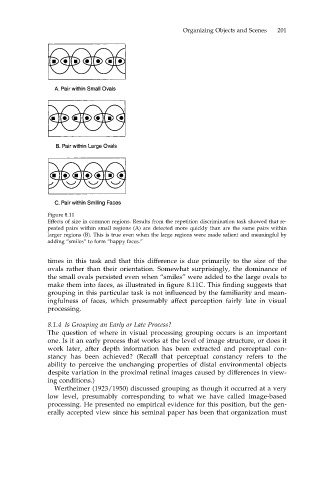
               Figure 8.11
               Effects of size in common regions. Results from the repetition discrimination task showed that re-
               peated pairs within small regions (A) are detected more quickly than are the same pairs within
               larger regions (B). This is true even when the large regions were made salient and meaningful by
               adding ‘‘smiles’’ to form ‘‘happy faces.’’

               times in this task and that this difference is due primarily to the size of the
               ovals rather than their orientation. Somewhat surprisingly, the dominance of
               the small ovals persisted even when ‘‘smiles’’ were added to the large ovals to
               make them into faces, as illustrated in figure 8.11C. This finding suggests that
               grouping in this particular task is not influenced by the familiarity and mean-
               ingfulness of faces, which presumably affect perception fairly late in visual
               processing.

               8.1.4 Is Grouping an Early or Late Process?
               The question of where in visual processing grouping occurs is an important
               one. Is it an early process that works at the level of image structure, or does it
               work later, after depth information has been extracted and perceptual con-
               stancy has been achieved? (Recall that perceptual constancy refers to the
               ability to perceive the unchanging properties of distal environmental objects
               despite variation in the proximal retinal images caused by differences in view-
               ing conditions.)
                 Wertheimer (1923/1950) discussed grouping as though it occurred at a very
               low level, presumably corresponding to what we have called image-based
               processing. He presented no empirical evidence for this position, but the gen-
               erally accepted view since his seminal paper has been that organization must

