


Page 200 - Foundations of Cognitive Psychology : Core Readings
P. 200
204   Stephen E. Palmer


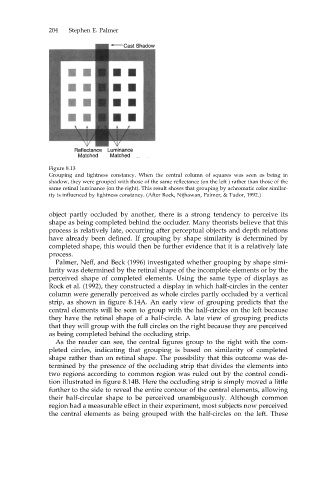
                Figure 8.13
                Grouping and lightness constancy. When the central column of squares was seen as being in
                shadow, they were grouped with those of the same reflectance (on the left ) rather than those of the
                same retinal luminance (on the right). This result shows that grouping by achromatic color similar-
                ity is influenced by lightness constancy. (After Rock, Nijhawan, Palmer, & Tudor, 1992.)


                objectpartlyoccludedbyanother,there is astrongtendencyto perceiveits
                shape as being completed behind the occluder. Many theorists believe that this
                process is relatively late, occurring after perceptual objects and depth relations
                have already been defined. If grouping by shape similarity is determined by
                completed shape, this would then be further evidence that it is a relatively late
                process.
                  Palmer, Neff, and Beck (1996) investigated whether grouping by shape simi-
                larity was determined by the retinal shape of the incomplete elements or by the
                perceived shape of completed elements. Using the same type of displays as
                Rock et al. (1992), they constructed a display in which half-circles in the center
                column were generally perceived as whole circles partly occluded by a vertical
                strip, as shown in figure 8.14A. An early view of grouping predicts that the
                central elements will be seen to group with the half-circles on the left because
                they have the retinal shape of a half-circle. A late view of grouping predicts
                that they will group with the full circles on the right because they are perceived
                as being completed behind the occluding strip.
                  As the reader can see, the central figures group to the right with the com-
                pleted circles, indicating that grouping is based on similarity of completed
                shape rather than on retinal shape. The possibility that this outcome was de-
                termined by the presence of the occluding strip that divides the elements into
                two regions according to common region was ruled out by the control condi-
                tion illustrated in figure 8.14B. Here the occluding strip is simply moved a little
                further to the side to reveal the entire contour of the central elements, allowing
                their half-circular shape to be perceived unambiguously. Although common
                region had a measurable effect in their experiment, most subjects now perceived
                the central elements as being grouped with the half-circles on the left. These

