


Page 203 - Foundations of Cognitive Psychology : Core Readings
P. 203
Organizing Objects and Scenes  207


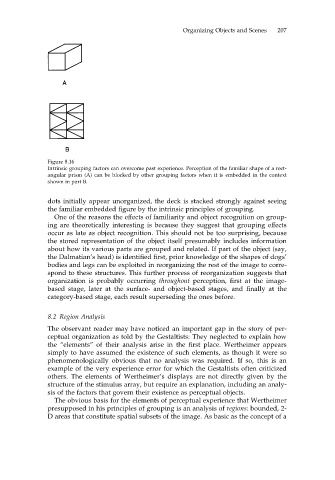
               Figure 8.16
               Intrinsic grouping factors can overcome past experience. Perception of the familiar shape of a rect-
               angular prism (A) can be blocked by other grouping factors when it is embedded in the context
               showninpart B.

               dots initially appear unorganized, the deck is stacked strongly against seeing
               the familiar embedded figure by the intrinsic principles of grouping.
                 One of the reasons the effects of familiarity and object recognition on group-
               ing are theoretically interesting is because they suggest that grouping effects
               occur as late as object recognition. This should not be too surprising, because
               the stored representation of the object itself presumably includes information
               about how its various parts are grouped and related. If part of the object (say,
               the Dalmatian’s head) is identified first, prior knowledge of the shapes of dogs’
               bodies and legs can be exploited in reorganizing the rest of the image to corre-
               spond to these structures. This further process of reorganization suggests that
               organization is probably occurring throughout perception, first at the image-
               based stage, later at the surface- and object-based stages, and finally at the
               category-based stage, each result superseding the ones before.


               8.2 Region Analysis
               The observant reader may have noticed an important gap in the story of per-
               ceptual organization as told by the Gestaltists: They neglected to explain how
               the ‘‘elements’’ of their analysis arise in the first place. Wertheimer appears
               simply to have assumed the existence of such elements, as though it were so
               phenomenologically obvious that no analysis was required. If so, this is an
               example of the very experience error for which the Gestaltists often criticized
               others. The elements of Wertheimer’s displays are not directly given by the
               structure of the stimulus array, but require an explanation, including an analy-
               sisofthe factorsthatgoverntheir existenceasperceptualobjects.
                 The obvious basis for the elements of perceptual experience that Wertheimer
               presupposed in his principles of grouping is an analysis of regions:bounded,2-
               D areas that constitute spatial subsets of the image. As basic as the concept of a

