


Page 205 - Foundations of Cognitive Psychology : Core Readings
P. 205
Organizing Objects and Scenes  209


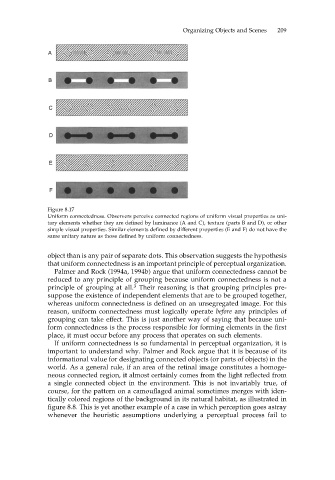
               Figure 8.17
               Uniform connectedness. Observers perceive connected regions of uniform visual properties as uni-
               tary elements whether they are defined by luminance (A and C), texture (parts B and D), or other
               simple visual properties. Similar elements defined by different properties (E and F) do not have the
               same unitary nature as those defined by uniform connectedness.

               object than is any pair of separate dots. This observation suggests the hypothesis
               that uniform connectedness is an important principle of perceptual organization.
                 Palmer and Rock (1994a, 1994b) argue that uniform connectedness cannot be
               reduced to any principle of grouping because uniform connectedness is not a
               principle of grouping at all. Their reasoning is that grouping principles pre-
                                         3
               suppose the existence of independent elements that are to be grouped together,
               whereas uniform connectedness is defined on an unsegregated image. For this
               reason, uniform connectedness must logically operate before any principles of
               grouping can take effect. This is just another way of saying that because uni-
               form connectedness is the process responsible for forming elements in the first
               place, it must occur before any process that operates on such elements.
                 If uniform connectedness is so fundamental in perceptual organization, it is
               important to understand why. Palmer and Rock argue that it is because of its
               informational value for designating connected objects (or parts of objects) in the
               world. As a general rule, if an area of the retinal image constitutes a homoge-
               neous connected region, it almost certainly comes from the light reflected from
               a single connected object in the environment. This is not invariably true, of
               course, for the pattern on a camouflaged animal sometimes merges with iden-
               tically colored regions of the background in its natural habitat, as illustrated in
               figure 8.8. This is yet another example of a case in which perception goes astray
               whenever the heuristic assumptions underlying a perceptual process fail to

