


Page 211 - Foundations of Cognitive Psychology : Core Readings
P. 211
216   Albert S. Bregman


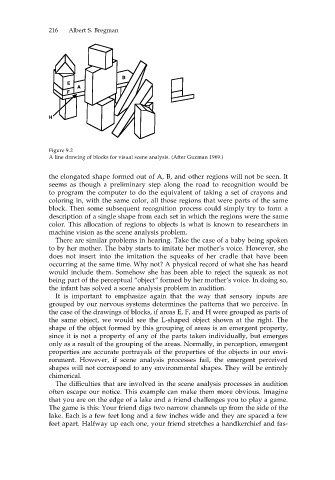
                Figure 9.2
                A line drawing of blocks for visual scene analysis. (After Guzman 1969.)


                the elongated shape formed out of A, B, and other regions will not be seen. It
                seems as though a preliminary step along the road to recognition would be
                to program the computer to do the equivalent of taking a set of crayons and
                coloring in, with the same color, all those regions that were parts of the same
                block. Then some subsequent recognition process could simply try to form a
                description of a single shape from each set in which the regions were the same
                color. This allocation of regions to objects is what is known to researchers in
                machine vision as the scene analysis problem.
                  There are similar problems in hearing. Take the case of a baby being spoken
                to by her mother. The baby starts to imitate her mother’s voice. However, she
                does not insert into the imitation the squeaks of her cradle that have been
                occurring at the same time. Why not? A physical record of what she has heard
                would include them. Somehow she has been able to reject the squeak as not
                being part of the perceptual ‘‘object’’ formed by her mother’s voice. In doing so,
                the infant has solved a scene analysis problem in audition.
                  It is important to emphasize again that the way that sensory inputs are
                grouped by our nervous systems determines the patterns that we perceive. In
                the case of the drawings of blocks, if areas E, F, and H were grouped as parts of
                the same object, we would see the L-shaped object shown at the right. The
                shape of the object formed by this grouping of areas is an emergent property,
                since it is not a property of any of the parts taken individually, but emerges
                only as a result of the grouping of the areas. Normally, in perception, emergent
                properties are accurate portrayals of the properties of the objects in our envi-
                ronment. However, if scene analysis processes fail, the emergent perceived
                shapes will not correspond to any environmental shapes. They will be entirely
                chimerical.
                  The difficulties that are involved in the scene analysis processes in audition
                oftenescapeour notice.Thisexample canmakethemmoreobvious.Imagine
                that you are on the edge of a lake and a friend challenges you to play a game.
                The game is this: Your friend digs two narrow channels up from the side of the
                lake. Each is a few feet long and a few inches wide and they are spaced a few
                feet apart. Halfway up each one, your friend stretches a handkerchief and fas-

