


Page 189 - Fundamentals of Probability and Statistics for Engineers
P. 189
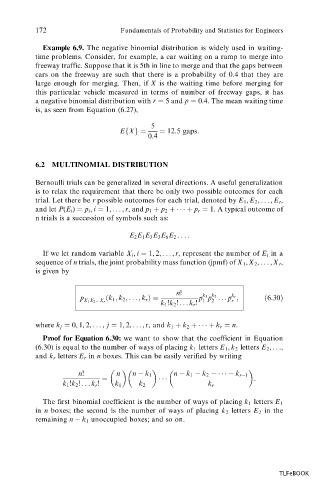
172 Fundamentals of Probability and Statistics for Engineers
Example 6.9. The negative binomial distribution is widely used in waiting-
time problems. Consider, for example, a car waiting on a ramp to merge into
freeway traffic. Suppose that it is 5th in line to merge and that the gaps between
cars on the freeway are such that there is a probability of 0.4 that they are
large enough for merging. Then, if X is the waiting time before merging for
this particular vehicle measured in terms of number of freeway gaps, it has
a negative binomial distribution with r 5 and p 0.4. The mean waiting time
is, as seen from Equation (6.27),
5
EfXg 12:5 gaps:
0:4
6.2 MULTINOMIAL DISTRIBUTION
Bernoulli trials can be generalized in several directions. A useful generalization
is to relax the requirement that there be only two possible outcomes for each
trial. Let there be r possible outcomes for each trial, denoted by E 1 , E 2 ,..., E r ,
and let P(E i ) p i , i 1, ... , r, and p 1 p 2 p r 1. A typical outcome of
n trials is a succession of symbols such as:
E 2 E 1 E 3 E 3 E 6 E 2 ... :
If we let random variable X i , i 1, 2, ... , r, represent the number of E i in a
sequence of n trials, the joint probability mass function (jpmf) of X 1 , X 2 ,.. . , X r ,
is given by
n!
p
k 1 ; k 2 ; ... ; k r p p .. . p ;
6:30
k 1 k 2
k r
X 1 X 2 ...X r 1 2 r
k 1 !k 2 !... k r !
where k j 0, 1, 2, . . . , j 1, 2, . . . , r, and k 1 k 2 k r n.
Proof for Equation 6.30: we want to show that the coefficient in Equation
(6.30) is equal to the number of ways of placing k 1 letters E 1 , k 2 letters E 2 ,.. .,
and k r letters E r in n boxes. This can be easily verified by writing
n! n k 1 n k 1 k 2 k r 1
n
:
k 1 !k 2 ! ... k r ! k 1 k 2 k r
The first binomial coefficient is the number of ways of placing k 1 letters E 1
in n boxes; the second is the number of ways of placing k 2 letters E 2 in the
unoccupied boxes; and so on.
remaining n k 1
TLFeBOOK

