


Page 190 - Fundamentals of Probability and Statistics for Engineers
P. 190
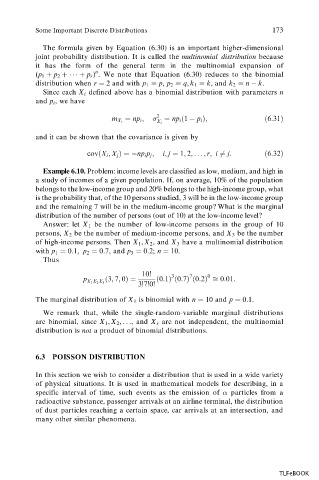
Some Important Discrete Distributions 173
The formula given by Equation (6.30) is an important higher-dimensional
joint probability distribution. It is called the multinomial distribution because
it has the form of the general term in the multinomial expansion of
n
(p 1 p 2 p r ) . We note that Equation (6.30) reduces to the binomial
distribution when r 2 and with p 1 p, p 2 q, k 1 k, and k 2 n k.
Since each X i defined above has a binomial distribution with parameters n
and p i , we have
np i ; 2 np i
1 p i ;
6:31
m X i
X i
and it can be shown that the covariance is given by
cov
X i ; X j np i p j ; i; j 1; 2; ... ; r; i 6 j:
6:32
Example 6.10. Problem: income levels are classified as low, medium, and high in
a study of incomes of a given population. If, on average, 10% of the population
belongs to the low-income group and 20% belongs to the high-income group, what
is the probability that, of the 10 persons studied, 3 will be in the low-income group
and the remaining 7 will be in the medium-income group? What is the marginal
distribution of the number of persons (out of 10) at the low-income level?
Answer: let X 1 be the number of low-income persons in the group of 10
persons, X 2 be the number of medium-income persons, and X 3 be the number
of high-income persons. Then X 1 , X 2 , and X 3 have a multinomial distribution
with p 1 0:1, p 2 0:7, and p 3 0:2; n 10.
Thus
10! 3 7 0
p
3; 7; 0
0:1
0:7
0:2 0:01:
3!7!0!
X 1 X 2 X 3
The marginal distribution of X 1 is binomial with n 10 and p 0:1.
We remark that, while the single-random-variable marginal distributions
are binomial, since X 1 , X 2 ,.. ., and X r are not independent, the multinomial
distribution is not a product of binomial distributions.
6.3 POISSON DISTRIBUTION
In this section we wish to consider a distribution that is used in a wide variety
of physical situations. It is used in mathematical models for describing, in a
specific interval of time, such events as the emission of particles from a
radioactive substance, passenger arrivals at an airline terminal, the distribution
of dust particles reaching a certain space, car arrivals at an intersection, and
many other similar phenomena.
TLFeBOOK

