


Page 191 - Fundamentals of Probability and Statistics for Engineers
P. 191
174 Fundamentals of Probability and Statistics for Engineers
To fix ideas in the following development, let us consider the problem of
passenger arrivals at a bus terminal during a specified time interval. We shall
use the notation X (0, t) to represent the number of arrivals during time interval
[0, t), where the notation [ ) denotes a left-closed and right-open interval; it is a
discrete random variable taking possible values 0, 1, 2, . . . , whose distribution
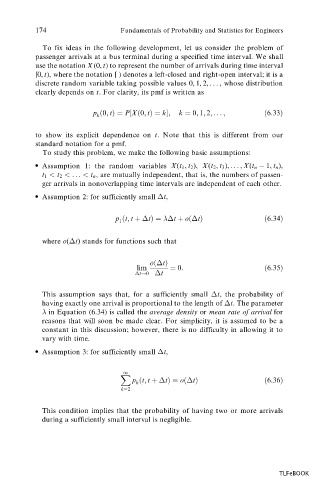
clearly depends on t. For clarity, its pmf is written as
p
0; t PX
0; t k; k 0; 1; 2; ... ;
6:33
k
to show its explicit dependence on t. Note that this is different from our
standard notation for a pmf.
To study this problem, we make the following basic assumptions:
. Assumption 1: the random variables X(t 1 , t 2 ), X(t 2 , t 3 ), ... , X(t n 1, t n ),
t 1 < t 2 < ... < t n ; are mutually independent, that is, the numbers of passen-
ger arrivals in nonoverlapping time intervals are independent of each other.
. Assumption 2: for sufficiently small t,
p
t; t t t o
t
6:34
1
where o( t) stands for functions such that
o
t
lim 0:
6:35
t!0 t
This assumption says that, for a sufficiently small t, the probability of
having exactly one arrival is proportional to the length of t. The parameter
in Equation (6.34) is called the average density or mean rate of arrival for
reasons that will soon be made clear. For simplicity, it is assumed to be a
constant in this discussion; however, there is no difficulty in allowing it to
vary with time.
. Assumption 3: for sufficiently small t,
1
X
p
t; t t o
t
6:36
k
k2
This condition implies that the probability of having two or more arrivals
during a sufficiently small interval is negligible.
TLFeBOOK

