


Page 279 - Fundamentals of Radar Signal Processing
P. 279
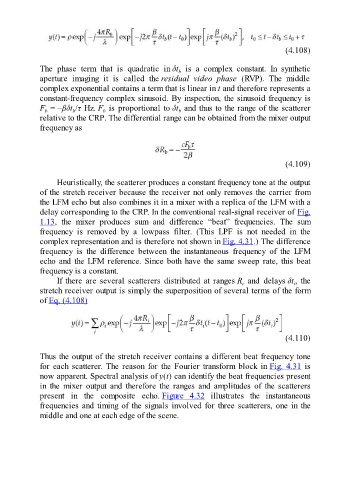
(4.108)

               The  phase  term  that  is  quadratic  in δt   is  a  complex  constant.  In  synthetic
                                                                b
               aperture  imaging  it  is  called  the residual  video  phase  (RVP).  The  middle

               complex exponential contains a term that is linear in t and therefore represents a
               constant-frequency complex sinusoid. By inspection, the sinusoid frequency is
               F  = –βδt /τ Hz. F  is proportional to δt  and thus to the range of the scatterer
                                                                b
                           b
                 b
                                     b
               relative to the CRP. The differential range can be obtained from the mixer output
               frequency as


                                                                                                     (4.109)

                     Heuristically, the scatterer produces a constant frequency tone at the output
               of the stretch receiver because the receiver not only removes the carrier from

               the LFM echo but also combines it in a mixer with a replica of the LFM with a
               delay corresponding to the CRP. In the conventional real-signal receiver of Fig.
               1.13,  the  mixer  produces  sum  and  difference  “beat”  frequencies.  The  sum
               frequency  is  removed  by  a  lowpass  filter.  (This  LPF  is  not  needed  in  the
               complex representation and is therefore not shown in Fig. 4.31.) The difference
               frequency  is  the  difference  between  the  instantaneous  frequency  of  the  LFM
               echo and the LFM reference. Since both have the same sweep rate, this beat

               frequency is a constant.
                     If  there  are  several  scatterers  distributed  at  ranges R  and  delays δt , the
                                                                                      i
                                                                                                        i
               stretch receiver output is simply the superposition of several terms of the form
               of Eq. (4.108)


                                                                                                     (4.110)


               Thus the output of the stretch receiver contains a different beat frequency tone

               for each scatterer. The reason for the Fourier transform block in Fig. 4.31 is
               now apparent. Spectral analysis of y(t) can identify the beat frequencies present
               in  the  mixer  output  and  therefore  the  ranges  and  amplitudes  of  the  scatterers
               present  in  the  composite  echo. Figure  4.32  illustrates  the  instantaneous
               frequencies and timing of the signals involved for three scatterers, one in the
               middle and one at each edge of the scene.

