


Page 281 - Fundamentals of Radar Signal Processing
P. 281
frequencies so as not to distort the scatterer amplitudes, but also a group delay             5
               of –δt  seconds at the frequency –β  · δt /τ. It can be shown that the required
                      b
                                                                b
                                                                                                     2
               frequency response in analog radian frequency units is H(Ω) = exp(–jΩ τ/2β ),
                                                                                                           Ω
               which  has  unit  magnitude  for  all  frequencies  and  a  quadratic  phase  in  the
               frequency domain (see Prob. 15). All of the beat frequencies will be aligned in
               time at the output of this filter. As an extra benefit, this filter also corrects RVP
               (Carrara et al., 1995).
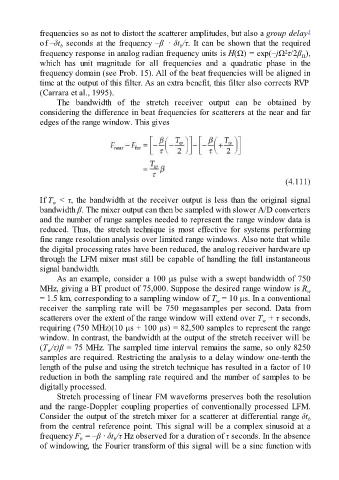
                     The  bandwidth  of  the  stretch  receiver  output  can  be  obtained  by
               considering the difference in beat frequencies for scatterers at the near and far
               edges of the range window. This gives


                                                                                                     (4.111)

               If T  < τ, the bandwidth at the receiver output is less than the original signal
                   w
               bandwidth β. The mixer output can then be sampled with slower A/D converters
               and the number of range samples needed to represent the range window data is

               reduced.  Thus,  the  stretch  technique  is  most  effective  for  systems  performing
               fine range resolution analysis over limited range windows. Also note that while
               the digital processing rates have been reduced, the analog receiver hardware up
               through the LFM mixer must still be capable of handling the full instantaneous
               signal bandwidth.
                     As an example, consider a 100 μs pulse with a swept bandwidth of 750
               MHz, giving a BT product of 75,000. Suppose the desired range window is R                     w

               = 1.5 km, corresponding to a sampling window of T  = 10 μs. In a conventional
                                                                             w
               receiver  the  sampling  rate  will  be  750  megasamples  per  second.  Data  from
               scatterers over the extent of the range window will extend over T  + τ seconds,
                                                                                             w
               requiring (750 MHz)(10 μs + 100 μs) = 82,500 samples to represent the range
               window. In contrast, the bandwidth at the output of the stretch receiver will be

               (T /τ)β = 75 MHz. The sampled time interval remains the same, so only 8250
                  w
               samples are required. Restricting the analysis to a delay window one-tenth the
               length of the pulse and using the stretch technique has resulted in a factor of 10
               reduction in both the sampling rate required and the number of samples to be
               digitally processed.
                     Stretch processing of linear FM waveforms preserves both the resolution
               and the range-Doppler coupling properties of conventionally processed LFM.
               Consider the output of the stretch mixer for a scatterer at differential range δt             b

               from the central reference point. This signal will be a complex sinusoid at a
               frequency F  = –β · δt /τ Hz observed for a duration of τ seconds. In the absence
                             b
                                         b
               of windowing, the Fourier transform of this signal will be a sinc function with

