


Page 280 - Fundamentals of Radar Signal Processing
P. 280
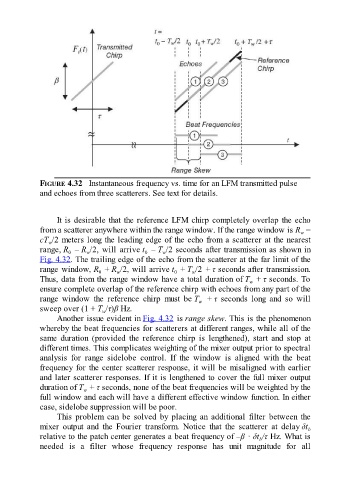
FIGURE 4.32   Instantaneous frequency vs. time for an LFM transmitted pulse
               and echoes from three scatterers. See text for details.


                     It is desirable that the reference LFM chirp completely overlap the echo
               from a scatterer anywhere within the range window. If the range window is R  =
                                                                                                          w
               cT /2 meters long the leading edge of the echo from a scatterer at the nearest
                  w
               range, R   – R /2, will arrive t   – T /2 seconds after transmission as shown in
                               w
                         0
                                                    0
                                                          w
               Fig. 4.32. The trailing edge of the echo from the scatterer at the far limit of the
               range window, R  + R /2, will arrive t  + T /2 + τ seconds after transmission.
                                                                    w
                                          w
                                    0
                                                              0
               Thus, data from the range window have a total duration of T  + τ seconds. To
                                                                                         w
               ensure complete overlap of the reference chirp with echoes from any part of the
               range  window  the  reference  chirp  must  be T   + τ  seconds  long  and  so  will
                                                                       w
               sweep over (1 + T /τ)β Hz.
                                     w
                     Another issue evident in Fig. 4.32 is range skew. This is the phenomenon
               whereby the beat frequencies for scatterers at different ranges, while all of the
               same  duration  (provided  the  reference  chirp  is  lengthened),  start  and  stop  at
               different times. This complicates weighting of the mixer output prior to spectral
               analysis  for  range  sidelobe  control.  If  the  window  is  aligned  with  the  beat
               frequency for the center scatterer response, it will be misaligned with earlier
               and later scatterer responses. If it is lengthened to cover the full mixer output
               duration of T  + τ seconds, none of the beat frequencies will be weighted by the
                              w
               full window and each will have a different effective window function. In either
               case, sidelobe suppression will be poor.

                     This  problem  can  be  solved  by  placing  an  additional  filter  between  the
               mixer  output  and  the  Fourier  transform.  Notice  that  the  scatterer  at  delay δt      b
               relative to the patch center generates a beat frequency of –β · δt /τ Hz. What is
                                                                                            b
               needed  is  a  filter  whose  frequency  response  has  unit  magnitude  for  all

