


Page 185 - Gas Purification 5E
P. 185
172   Gas Purijkation


                    Design criteria for LPG water wash systems are reviewed by Stewart and Lanning (1991,
                   1994AI B). For a gravity settler as shown in Figure 2-96, they recommend LPG and wash
                   water residence times of  15 and 20 minutes, respectively. They also recommend that the
                   water make-up rate be  set to produce a wash water purge to the amine system containing
                   about 3 wt% amine. Although solubility data such as those of Veldman (1989) can be used
                   to estimate amine solubility losses in the LPG, it is probably better to use an experience fac-
                   tor, such as on 0.02 lb of  amine per bane1 of  LPG feed (about 100 ppmw), as this figure
                   includes amine entrainment. Note that poorly designed systems with high superficial veloci-
                   ties or with inadequate LPG residence times in the LPG amine contactor can have amine
                   losses as high as 500 ppmw (Veldman, 1989). While there is considerable variation, typical
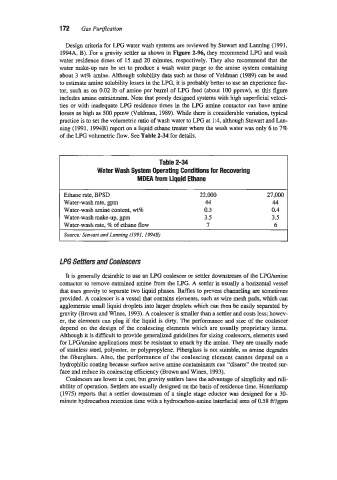
                   practice is to set the volumetric ratio of wash water to LPG at 1:4, although Stewart and Lan-
                   ning (1991, 1994B) report on a liquid ethane treater where the wash water was only 6 to 7%
                   of the LPG volumetric flow. See Table 2-34 for details.


                                                Table 2-34
                              Water Wash System Operating Conditions for Recovering
                                          MDEA from Liquid Ethane

                    Ethane rate, BPSD                       22,000              27,000
                    Water-wash rate, gpm                      44                 44
                    Water-wash amine content, wt%            0.3                 0.4
                    Water-wash make-up: gpm                  3.5                 3.5
                    Water-wash rate, 9 of ethane flow         7                   6
                   w   a  r   t and Lanning (1991.1994B)


                   LPG Settlers and Coalescers
                    It is generally desirable to use an LPG coalescer or settler downstream of the LPG/amine
                   contactor to remove entrained amine from the LPG. A settler is usually a horizontal vessel
                   that uses gravity to separate two liquid phases. Baffles to prevent channeling are sometimes
                   provided. A coalescer is a vessel that contains elements, such as wire mesh pads, which can
                   agglomerate small liquid droplets into larger droplets which can then be easily separated by
                   gravity (Brown and Wines, 1993). A coalescer is smaller than a settler and costs less; howev-
                   er, the elements can plug if the liquid is dirty. The performance  and size of  the coalescer
                   depend on the design  of  the coalescing elements which are usually proprietary  items.
                   Although it is difficult to provide generalized guidelines for sizing coalescers, elements used
                   for LPG/amine applications must be resistant to attack by the amine. They are usually made
                   of stainless steel, polyester, or polypropylene. Fiberglass is not suitable, as amine degrades
                   the fiberglass.  Also, the performance  of  the coalescing element cannot depend on a
                   hydrophilic coating because surface active amine contaminants can “disarm” the treated sur-
                   face and reduce its coalescing efficiency (Brown and Wines, 1993).
                     Coalescers are lower in cost, but gravity settlers have the advantage of simplicity and reli-
                   ability of operation. Settlers are usually designed on the basis of residence time. Honerkamp
                   (1975) reports that a settler downstream of  a single stage eductor was designed for a 30-
                   minute hydrocarbon retention time with a hydrocarbon-amine interfacial area of 0.58 ftVgpm

