


Page 257 - Gas Purification 5E
P. 257
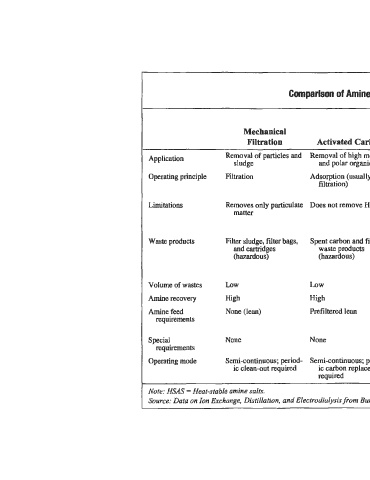
Table 3-6
                                                   Comparison of Amine Solution Purlfication Techniques
                                                                         Distillation
                                           Mechanical                     (thermal
                                            Filtration   Activated Carbon   reclaiming)   Ion Exchange   Electrodialysis
                           Application   Removal of particles and  Removal of high mol. wt.  Removal of all solids and  Removal of ionized   Removal of ionized
                                                                       nonvolatile species
                                                                                      impuntie$
                                         sludge
                                                        and polar organics
                                                                                                    impurities
                           Operating principle   Filtration   Adsorption (usually with  Vaporization  of volatile   Ions am captured by ion   Ions are moved by elec-
                                                        filtration)    species (amine, water,   exchange resin   tricity from amine to
                                                                       etc.)                        waste soh.
                           Limitations   Removes only paaiculate  Does not remove HSAS  Energy intensiye. Some   Does not remove nonion-  Does not remove
                                         matter                        amines requlre   ic species. Best for   nonionic species.
                                                                       vacuum         low salt conc.   Best for moderate
                                                                                                    to high salt concs.
                           Waste products   Filter sludge, filter bags,  Spent carbon and filter   Reclaimer bottoms, con-  Dilute aqueous stream   Brine containing
                                         and cartridges   waste products   taining salts, non-   containing removed   removed ions
                                         (hazardous)    (hazardous)    volatile qrganics and   ions plus excess regen-
                                                                       some amine     eration and rinse water
                                                                       (hazardous)
                                                                                    High  -
                           Volume of wastes   LOW      LOW           LOW            High (about 99%)   Moderate
                           Amine recovery   High       High          Moderate (about 85-9591       High (about 98%)
                                                                                    Cool, lean, hydrocarbon
                           Amine feed   None (lean)    Prefiltered lean   HSAS neutralized   and particulate free   Cool, lean, hydrocarbon
                            requirements                                                            and particulate free;
                                                                                    Regeneration chemicals   HSAS neutralized
                                                                                      I
                           Spid         None           None          Fuel gas or high temp.        D.C. power supply
                            requirements                               heat source
                                                                                    Semi-continuous, batch or
                           Operating mode   Semi-continuous; period-  Semi-continuous; period-  Batch or on-line; mobile   on-line, mobile units   Continuous on-line,
                                         ic clean-out required   ic carbon replacement   units available   available   or batch, mobile units
                                                        required                                    a v  ai 1 ab 1 e
                                             ~~
                           Note: HSAS = Heat-stable amine salts.
                           Source: Data on Ion Exchange, DistiIlution, and Electmdiulysis from Burns and Gregory (1995)

