


Page 252 - Gas Purification 5E
P. 252
238    Gas PuriJcation


                     Meisen and Kennard (1982) suggest that the most important measures to control DEA
                   degradation are to keep reboiler and heat exchanger temperatures at the lowest practical lev-
                   els, to maximize circulation through the reboiler, and to operate with relatively low DEA
                   concentrations. Furthermore, they found in laboratory experiments that filtration through
                   activated charcoal did not remove degradation products of DEA and COP This observation
                   is contrary to the experience of other investigators, notably that reported by Perry. However,
                   Perry (1974) did not distinguish COz-amine degradation products from other solution conta-
                   minants and degradation products.
                     Polderman and Steele (1956) and Polderman et al. (1955A, B) report that under certain
                   conditions, the degradation of  diethanolamine by  COz is significantly faster than that of
                   monoethanolamine. For example, when  an aqueous solution containing 20 wt% of  either
                   amine saturated with COz was heated for 8 hours at a pressure of 250 psig and 259"F, 22%
                   of the diethanolamine was converted, while practically no conversion of monoethanolamine
                   was observed. In actual plant operation, lower rates of diethanolamine conversion have been
                   observed compared to monoethanolamine.  This seeming inconsistency with the reported lab-
                   oratory results may be explained by the fact that the vapor-liquid equilibrium relationships of
                   the systems, monoethanolamine-COz and diethanolamine-COz, are such that in the reboiler
                   (the point of highest temperature) of a plant using diethanolamine, the solution is essentially
                   free of COz. On the other hand, appreciable amounts of  COz are left in monoethanolamine
                   solutions at the same point of the plant.

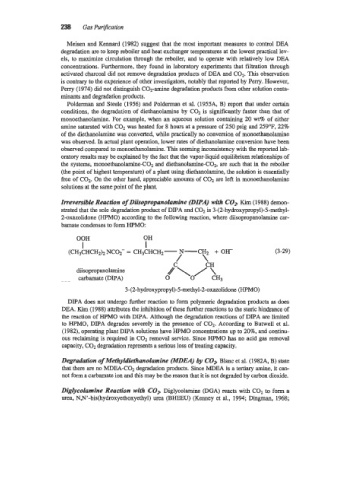
                   Irreversible Reaction of Diisopropanolamine (DIPA) with C02 Kim (1988) demon-
                   strated that the sole degradation product of DIPA and COz is 3-(2-hydroxypropyl)-5-methyl-
                   2-oxazolidone (HPMO) according to the following reaction, where diisopropanolamine car-
                   bamate condenses to form HPMO:
                        OOH                 OH
                          I                 I
                     (CH~CHCHZ)~ NC02-  = CH3CHCH2-   N-CH2      + OH             (3-29)
                                                     /       \
                        diisopropanolamine
                        carbamate (DIPA)
                                      3-(2-hydroxypropyl)-5-methyl-2-oxazolidone (HPMO)
                     DIPA does not undergo further reaction to form polymeric degradation products as does
                   DEA. Kim (1988) attributes the inhibition of these further reactions to the steric hindrance of
                   the reaction of  HPMO with DIPA. Although the degradation reactions of DIPA are limited
                   to HPMO, DIPA degrades severely in the presence of  COz. According to Butwell et al.
                    (1982), operating plant DIPA solutions have HPMO concentrations up to 20%, and continu-
                    ous reclaiming is required in COz removal service. Since HPMO has no acid gas removal
                   capacity, COz degradation represents a serious loss of treating capacity.

                   Degradation of Methyldiethanolamine (MDEA) by COP Blanc et al. (1982A, B) state
                   that there are no MDEA-COz degradation products. Since MDEA is a tertiary amine, it can-
                    not form a carbamate ion and this may be the reason that it is not degraded by carbon dioxide.

                   Diglycolamine Reaction with COP Diglycolamine (DGA) reacts with COz to  form a
                   urea, N,N'-bis(hydroxyethoxyethy1)  urea (BHEEU) (Kenney et al.,  1994; Dingman,  1968;

