


Page 250 - Gas Purification 5E
P. 250
236    Gas Punpcation

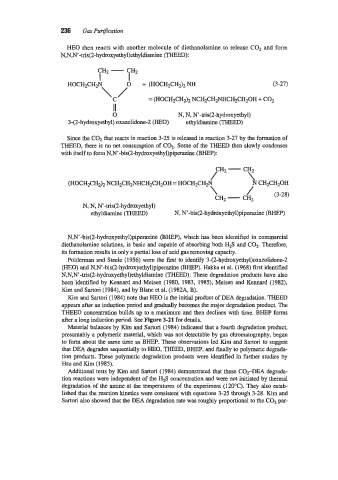
                     HE0 then reacts with another molecule of  diethanolamine to release C02 and form
                   N,N,N’-tris(2-hydroxyethyl)ethyldiamine (THEED):
                               ‘
                              CH2 - CH2
                               I       I
                                                         NH
                     HOCH2CH2N      /”     + (HOCH~CHZ)~                          (3-27)
                                   C
                                             = (HOCH2CH&  NCH2CH2NHCH2CH20H + COz
                                   II
                                  0                   N, N, N’-tris(2-hydroxyethyl)
                     3-(2-hydroxyethyl) oxazolidone-2 (HEO)   ethyldiamine (THEED)

                     Since the C02 that reacts in reaction 3-25 is released in reaction 3-27 by the formation of
                   THEED, there is no net consumption of  COP Some of  the =ED   then slowly condenses
                   with itself to form N,N’-bis(2-hydroxyethyl)piperazine  (BHEP):


                     (HOCH2CH2)2 NCH~CH~NHCHZCH~OH HOCHzCH2N 7-7  ,N          CH2CW:”,
                                                    =
                                                                \        CH2
                                                                 CH2 -

                          N, N, N’-tris(2-hydroxyethyl)
                            ethyldiamine (THEED)     N, N’-bis(2-hydroxyethyl)piperazine (BHEP)


                     N,N’-bis(2-hydroxyethyl)piperazine (BHEP), which has been identified in commercial
                   diethanolamine solutions, is basic and capable of  absorbing both H2S  and COP Therefore,
                   its formation results in only a partial loss of acid gas removing capacity.
                     Polderman and Steele (1956) were the first to identify 3-(2-hydroxyethyl)oxazolidone-2
                   (HEO) and N,N’-bis(2-hydroxyethyl)piperazine (BHEP). Hakka et al. (1968) first identified
                   N,N,N’-tris(2-hydroxyethyl)ethyldiamine (THEED). These degradation products have  also
                   been  identified by  Kennard  and Meisen (1980, 1983, 1985), Meisen and Kennard (1982),
                   Kim and Sartori (1984), and by Blanc et al. (1982A, €3).
                     Kim and Sartori (1984) note that HE0 is the initial product of DEA degradation. THEED
                   appears after an induction period and gradually becomes the major degradation product. The
                   THEED concentration builds up  to a maximum and then declines with time. BHEP forms
                   after a long induction period. See Figure 3-21 for details.
                     Material balances by Kim and Sartori (1984) indicated that a fourth degradation product,
                   presumably a polymeric material, which was not detectable by gas chromatography, began
                   to form about the same time as BHEP. These observations led Kim and Sartori to suggest
                   that DEA degrades sequentially to HEO, THEED, BHEP, and finally to polymeric degrada-
                   tion products. These polymeric degradation products were identified in further studies by
                   Hsu and Kim (1985).
                     Additional tests by  Kim and Sartori (1984) demonstrated that these C02-DEA  degrada-
                   tion reactions were independent of the H2S concentration and were not initiated by thermal
                   degradation of  the amine at the temperatures of  the experiment (120°C). They also estab-
                   lished that the reaction kinetics were consistent with equations 3-25 through 3-28. Kim and
                   Sartori also showed that the DEA degradation rate was roughly proportional to the C02 par-

