


Page 249 - Gas Purification 5E
P. 249
Mechanical Design and Operation of Alkanolamine Plants   235
                             CH2 -
                                     CH2
                              I       I
                    HOCHzCHzN        NH + H20 = HOCH2CH2NHCH2CH2NH2 + COz        (3-24)
                              \/
                                  C
                                  II
                                  0
                    1-(2-hydroxyethyl)-imidazolidone-2  N-(2-hydroxyethyl)-ethylenediamine (HEED)


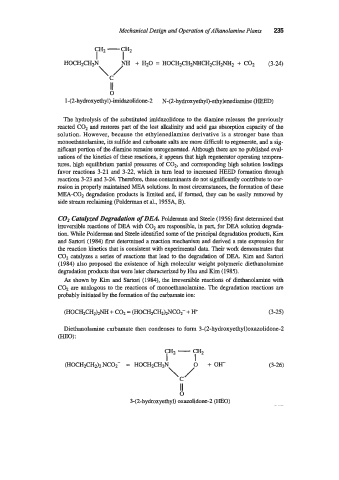
                    The hydrolysis of  the substituted imidazolidone to the diamine releases the previously
                  reacted COz and restores part of the lost alkalinity and acid gas absorption capacity of the
                  solution.  However, because  the ethylenediamine  derivative  is a stronger base  than
                  monoethanolamine, its sulfide and carbonate salts are more difficult to regenerate, and a sig-
                  nificant portion of the diamine remains unregenerated. Although there are no published eval-
                  uations of the kinetics of these reactions, it appears that high regenerator operating tempera-
                  tures, high equilibrium partial pressures  of COz, and corresponding high solution loadings
                  favor reactions 3-21 and 3-22, which in turn lead to increased HEED formation through
                  reactions 3-23 and 3-24. Therefore, these contaminants do not significantly contribute to cor-
                  rosion in properly maintained MEA solutions. In most circumstances, the formation of these
                  MEA-C02 degradation products is limited and, if formed, they can be easily removed by
                  side stream reclaiming (Polderman et al., 1955A, B).

                  C02 Catalyzed Degradation of DEA. Polderman and Steele (1956) first determined that
                  irreversible reactions of DEA with COz are responsible, in part, for DEA solution degrada-
                  tion. While Polderman and Steele identified some of the principal degradation products, Kim
                  and Sartori (1984) first determined a reaction mechanism and derived a rate expression for
                  the reaction kinetics that is consistent with experimental data. Their work demonstrates that
                  COz catalyzes a series of reactions that lead to the degradation of  DEA. Kim and Sartori
                  (1984) also proposed the existence of  high molecular weight polymeric diethanolamine
                  degradation products that were later characterized by Hsu and Kim (1985).
                    As shown by  Kim and Sartori (1984), the irreversible reactions  of  diethanolamine with
                  C02 are analogous to the reactions of  monoethanolamine. The degradation reactions are
                  probably initiated by the formation of the carbamate ion:

                    (HOCH2CHz)zNH + COZ = (HOCH2CH2)2NCOZ- + H+                  (3-25)

                    Diethanolamine carbamate then condenses to form 3-(2-hydroxyethyl)oxazolidone-2
                  (HEO):
                                                  CH2 - CH2
                                                   I       I
                    (HOCH2CH2)2 NC02-  =  HOCH2CH2N                              (3-26)
                                                       C
                                                   \ /" +OH
                                                       It
                                                       0
                                        3-(2-hydroxyethyl) oxazolidone-2 (HEO)

