


Page 281 - Gas Purification 5E
P. 281
Mechanical Design and Operation of Alkanolarnine Plants   265


                                      A       C       A      C

                                                 Repeating Unit
                               A = anion exchange membrane
                               C = cation exchange membrane
                               Many repeating units are stacked between two electrodes.
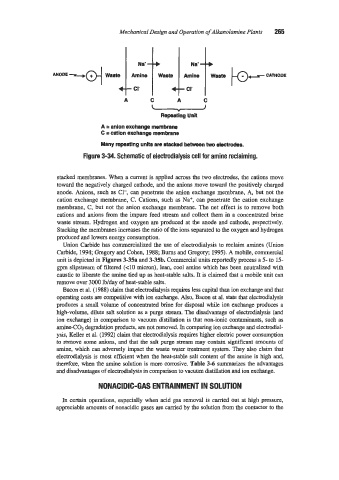
                          Figure 3-34. Schematic of electrodialysis cell for amine reclaiming.


                  stacked membranes. When a current is applied across the two electrodes, the cations move
                  toward the negatively charged cathode, and the anions move toward the positively charged
                  anode. Anions, such as C1-,  can penetrate the anion exchange membrane, A, but not  the
                  cation exchange membrane, C.  Cations, such as Na+, can penetrate the cation exchange
                  membrane, C, but not the anion exchange membrane. The net effect is to remove both
                  cations and anions from the impure feed stream and collect them in a concentrated brine
                  waste  stream. Hydrogen and oxygen are produced  at the anode and cathode, respectively.
                  Stacking the membranes increases the ratio of the ions separated to the oxygen and hydrogen
                  produced and lowers energy consumption.
                    Union  Carbide has commercialized the use of  electrodialysis to reclaim amines (Union
                  Carbide, 1994; Gregory and Cohen, 1988; Bums and Gregory;  1995). A mobile, commercial
                  unit is depicted in Figures 3-35a and 3-35b. Commercial units reportedly process a 5- to 15-
                  gprn slipstream of  filtered (40 micron), lean, cool amine which has been neutralized with
                  caustic to liberate the amine tied up as heat-stable salts. It is claimed that a mobile unit can
                  remove over 3000 lb/day of heat-stable salts.
                    Bacon et al. (1988) claim that electrodialysis quires less capital than ion exchange and that
                  operating costs are competitive with ion exchange. Also, Bacon et al. state that electrodialysis
                  produces  a small volume of  concentrated brine for disposal while ion exchange produces a
                  high-volume, dilute salt solution as a purge stream. The disadvantage of  electrodialysis (and
                  ion exchange) in comparison to vacuum distillation is that non-ionic contaminants, such as
                  amine-C02  degradation products, are not removed. In comparing ion exchange and electrodial-
                  ysis, Keller et al. (1992) claim that electrodialysis requires higher electric power consumption
                  to remove some anions, and that the salt purge stream may contain significant amounts of
                  amine, which can adversely impact the waste water treatment system. They also claim that
                  electrodialysis is most efficient when the heat-stable salt content of  the amine is high and,
                  therefore, when the amine solution is more corrosive. Table 3-6 summarizes the advantages
                  ahd disadvantages of electrodialysis in comparison to vacuum distillation and ion exchange.
                              NONACIDIC-GAS ENTRAINMENT IN SOLUTION

                    In certain operations, especially when acid gas removal is carried out at high pressure,
                  appreciable amounts of nonacidic gases are carried by the solution from the contactor to the

