


Page 283 - Gas Purification 5E
P. 283
Mechanical Design and Operation of Alkanolarnine Plants   267

                  regeneration section of the plant. This is particularly undesirable if the acid gases are intend-
                  ed to be used further, as for instance, for the production of dry ice or elemental sulfur, The
                  nonacidic gas may be carried both in solution and as entrained bubbles (or as drops of liquid
                  hydrocarbon). Mechanical canyover of nonacidic gases can be minimized by proper design
                  of the bottom section of the contactor. Both splashing and the free fall of liquids through the
                  vapor space (which result in hth in the bottom of the contactor) should be avoided by the
                  installation of  a properly designed downcomer, and the outlet line should include a vortex
                  breaker. Even when the contactor bottom is properly designed, it is in most cases impossible
                  to eliminate totally mechanical canyover. In addition, the solubility of most nonacidic gases
                  in ethanolamine solutions becomes appreciable at high pressures. Provisions, therefore, must
                  be made to separate these gases from the solution after it leaves the contactor and before it
                  enters the regenerating section. Depending on the operating conditions of the plant and the
                  purity requirements of the acid gas, a rich amine flash drum is often installed downstream of
                  the rich solution level control valve and upstream of the lean-to-rich solution heat exchanger.
                  To provide a maximum of vapor-disengaging area, horizontal vessels are frequently used.
                    The gases evolved in the rich amine flash drum contain acid gas in varying concentrations.
                  This acid gas can be recovered by contacting the flashed gases with a small stream of lean
                   amine solution in a small column installed at the top of the flash drum (see Chapter 2).
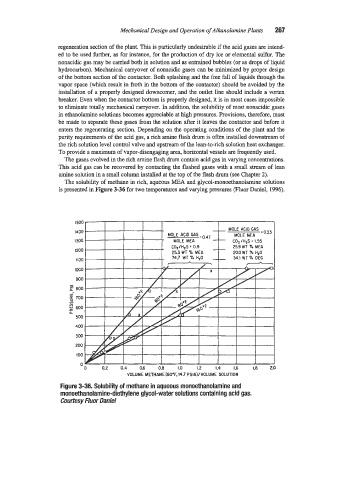
                    The solubility of methane in rich, aqueous MEA and glycol-monoethanolamine solutions
                   is presented in Figure 3-36 for two temperatures and varying pressures (Fluor Daniel, 1996).


                                       VOLUME METHANE (60*F, 14.7  PSIAIIVOLUME SOLUTION
                   Ftgure 3-36. Solubility of methane in aqueous monoethanolamine and
                   monoethanolamine-diethylene glycol-water solutions containing acid gas.
                   Courtesy Fluor Daniel

