


Page 278 - Gas Purification 5E
P. 278
262   GasPuriJcation
                                      4
                                        STEAM


                                I
                                                           CONDENSER      VACUUM
                                                                          PUMP
                         STRIPPING   REBOILER   PURIFICATION   CONDENSATE  CONDENSAT-  E
                          STILL               KETTLE       PUMP   ACCUMULATOR
                           @ PRESSURE INDICATOR   @ TEMPERATURE INDICATOR
                           0 INDICATOR            @ TEMPERATURE RECORDER  CONTROLLER
                              FLOW
                           @ LIQUID  LEVEL CONTROLLER
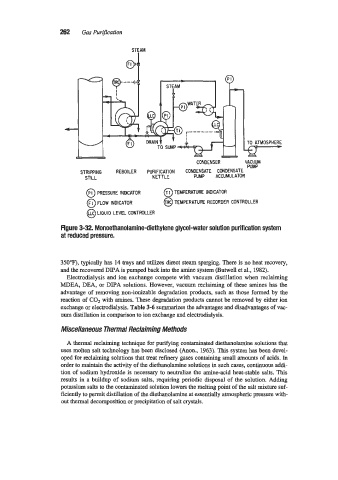
                   Figure 3-32. Monoethanolamine-diethylene glycol-water solution purification system
                   at reduced pressure.


                   350"F), typically has 14 trays and utilizes direct steam sparging. There is no heat recovery,
                   and the recovered DIPA is pumped back into the amine system (Butwell et al., 1982).
                     Electrodialysis  and ion exchange compete with vacuum distillation when reclaiming
                   MDEA, DEA, or DIPA solutions. However, vacuum reclaiming of  these amines has the
                   advantage of removing non-ionizable degradation products, such as those formed by  the
                   reaction of COz with amines. These degradation products cannot be removed by either ion
                   exchange or electrodialysis.  Table 3-6 summarizes the advantages and disadvantages of vac-
                   uum distillation in comparison to ion exchange and electrodialysis.
                   Miscellaneous Thermal Reclaiming Methods

                     A thermal reclaiming technique for purifying contaminated diethanolamine solutions that
                   uses molten salt technology has been disclosed (Anon.,  1963). This system has been devel-
                   oped for reclaiming solutions that treat refinery gases containing small amounts of  acids. In
                   order to maintain the activity of the diethanolamine solutions in such cases, continuous addi-
                   tion of  sodium hydroxide is necessary to neutralize the amine-acid heat-stable salts. This
                   results in a buildup of  sodium salts, requiring periodic disposal of  the solution. Adding
                   potassium salts to the contaminated solution lowers the melting point of the salt mixture suf-
                   ficiently to permit distillation of the diethanolamine at essentially atmospheric pressure with-
                   out thermal decomposition  or precipitation of salt crystals.

