


Page 115 - gas transport in porous media
P. 115
108
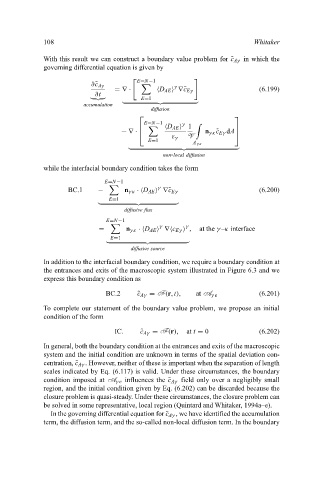
                           With this result we can construct a boundary value problem for ˜c Aγ in which the
                           governing differential equation is given by                 Whitaker

                                                     E=N−1
                                        ∂˜c Aγ                  γ
                                               =∇ ·         D AE   ∇˜c Eγ               (6.199)
                                          ∂t
                                                       E=1

                                      accumulation
                                                         diffusion
                                                      ⎡                          ⎤
                                                       E=N−1      γ
                                                              D AE   1
                                                      ⎢                          ⎥
                                                 −∇ · ⎣             V    n γκ ˜c Eγ dA⎦
                                                               ε γ
                                                         E=1
                                                                     A γκ

                                                             non-local diffusion
                           while the interfacial boundary condition takes the form
                                            E=N−1
                                                           γ
                                  BC.1    −       n γκ · D AE   ∇˜c Eγ                  (6.200)
                                             E=1

                                                  diffusive flux
                                             E=N−1

                                                                   γ
                                                            γ
                                           =      n γκ · D AE   ∇ c Eγ   ,  at the γ –κ interface
                                              E=1

                                                    diffusive source
                           In addition to the interfacial boundary condition, we require a boundary condition at
                           the entrances and exits of the macroscopic system illustrated in Figure 6.3 and we
                           express this boundary condition as
                                             BC.2     ˜ c Aγ = F (r, t),  at A γ e      (6.201)
                           To complete our statement of the boundary value problem, we propose an initial
                           condition of the form

                                               IC.     ˜ c Aγ = F (r),  at t = 0        (6.202)
                           In general, both the boundary condition at the entrances and exits of the macroscopic
                           system and the initial condition are unknown in terms of the spatial deviation con-
                           centration, ˜c Aγ . However, neither of these is important when the separation of length
                           scales indicated by Eq. (6.117) is valid. Under these circumstances, the boundary
                           condition imposed at A γ e influences the ˜c Aγ field only over a negligibly small
                           region, and the initial condition given by Eq. (6.202) can be discarded because the
                           closure problem is quasi-steady. Under these circumstances, the closure problem can
                           be solved in some representative, local region (Quintard and Whitaker, 1994a–e).
                             In the governing differential equation for ˜c Aγ , we have identified the accumulation
                           term, the diffusion term, and the so-called non-local diffusion term. In the boundary

