


Page 117 - gas transport in porous media
P. 117
110
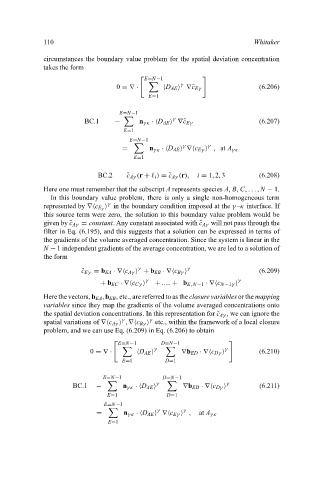
                           circumstances the boundary value problem for the spatial deviation concentration
                           takes the form                                              Whitaker
                                                        E=N−1


                                                                  γ
                                                0 =∇ ·        D AE   ∇˜c Eγ             (6.206)
                                                         E=1
                                                E=N−1

                                                                γ
                                       BC.1    −      n γκ · D AE   ∇˜c Eγ              (6.207)
                                                  E=1
                                                   E=N−1

                                                                  γ       γ
                                                 =       n γκ · D AE   ∇ c Eγ   ,at A γκ
                                                     E=1
                                          BC.2     ˜ c Aγ (r +   i ) =˜c Aγ (r),  i = 1, 2, 3  (6.208)
                           Here one must remember that the subscript A represents species A, B, C, ... , N − 1.
                             In this boundary value problem, there is only a single non-homogeneous term
                                             γ
                                              in the boundary condition imposed at the γ –κ interface. If
                           represented by ∇ c E γ
                           this source term were zero, the solution to this boundary value problem would be
                           given by ˜c Aγ = constant. Any constant associated with ˜c Aγ will not pass through the
                           filter in Eq. (6.195), and this suggests that a solution can be expressed in terms of
                           the gradients of the volume averaged concentration. Since the system is linear in the
                           N − 1 independent gradients of the average concentration, we are led to a solution of
                           the form
                                                      γ             γ
                                      ˜ c Eγ = b EA ·∇ c Aγ   + b EB ·∇ c Bγ            (6.209)
                                                        γ                         γ
                                           + b EC ·∇ c Cγ    + ..... + b E, N−1 ·∇ c N−1γ
                           Here the vectors, b EA , b EB , etc., are referred to as the closure variables or the mapping
                           variables since they map the gradients of the volume averaged concentrations onto
                           the spatial deviation concentrations. In this representation for ˜c Aγ , we can ignore the
                                                         γ
                                                 γ
                           spatial variations of ∇ c Aγ   , ∇ c Bγ   etc., within the framework of a local closure
                           problem, and we can use Eq. (6.209) in Eq. (6.206) to obtain

                                                E=N−1       D=N−1

                                                          γ                   γ
                                        0 =∇ ·        D AE        ∇b ED ·∇ c Dγ         (6.210)
                                                 E=1         D=1
                                            E=N−1            D=N−1
                                                           γ                   γ
                                   BC.1   −       n γκ · D AE     ∇b ED ·∇ c Dγ         (6.211)
                                             E=1              D=1
                                            E=N−1
                                                           γ       γ
                                          =       n γκ · D AE   ∇ c Eγ   ,  at A γκ
                                             E=1

