


Page 121 - gas transport in porous media
P. 121
114
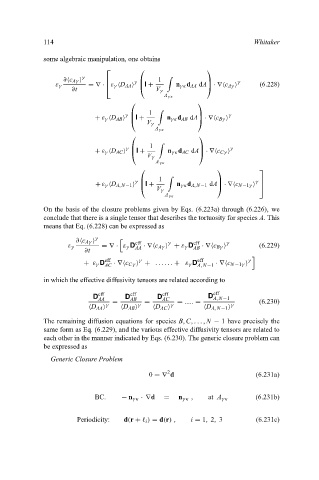
                           some algebraic manipulation, one obtains
                                             ⎡        ⎛                  ⎞             Whitaker
                                      γ
                                 ∂ c Aγ                    1
                                             ⎢       γ ⎜                 ⎟        γ
                              ε γ       =∇ · ⎣ε γ  D AA   ⎝I +   n γκ d AA dA⎠ ·∇ c Aγ    (6.228)
                                   ∂t                      V γ
                                                             A γκ
                                                    ⎛                  ⎞

                                                         1
                                                  γ ⎜                  ⎟       γ
                                          + ε γ  D AB   ⎝I +  n γκ d AB dA⎠ ·∇ c Bγ
                                                        V γ
                                                           A γκ
                                                    ⎛                  ⎞

                                                         1
                                                  γ ⎜                  ⎟        γ
                                          + ε γ  D AC   ⎝I +  n γκ d AC dA⎠ ·∇ c Cγ
                                                        V γ
                                                           A γκ
                                                      ⎛                     ⎞           ⎤

                                                            1
                                                     γ ⎜                    ⎟          γ ⎥
                                          + ε γ  D A, N−1   ⎝I +  n γκ d A, N−1 dA⎠ ·∇ c N−1γ   ⎦
                                                           V γ
                                                             A γκ
                           On the basis of the closure problems given by Eqs. (6.223a) through (6.226), we
                           conclude that there is a single tensor that describes the tortuosity for species A. This
                           means that Eq. (6.228) can be expressed as
                                          γ
                                    ∂ c Aγ           eff      γ      eff       γ
                                  ε γ      =∇ · ε γ D AA  ·∇ c Aγ   + ε γ D AB  ·∇ c Bγ    (6.229)
                                       ∂t

                                      + ε γ D eff  ·∇ c Cγ   + ...... + ε γ D eff  ·∇ c N−1γ   γ
                                                      γ
                                            AC
                                                                       A, N−1
                           in which the effective diffusivity tensors are related according to
                                         D eff    D eff    D eff          D eff
                                                                           A, N−1
                                                             AC
                                          AA
                                                    AB
                                             γ  =     γ  =     γ  = ..... =     γ       (6.230)
                                         D AA     D AB     D AC          D A, N−1
                           The remaining diffusion equations for species B, C, ... , N − 1 have precisely the
                           same form as Eq. (6.229), and the various effective diffusivity tensors are related to
                           each other in the manner indicated by Eqs. (6.230). The generic closure problem can
                           be expressed as
                             Generic Closure Problem
                                                              2
                                                         0 =∇ d                        (6.231a)
                                         BC.     − n γκ ·∇d  =   n γκ ,   at A γκ      (6.231b)


                                    Periodicity:  d(r +   i ) = d(r) ,  i = 1, 2, 3    (6.231c)

