


Page 192 - gas transport in porous media
P. 192
Khanafer and Vafai
                           186
                             Jian et al. (2001) analyzed numerically natural convection flow from a vertical
                           flat plate with a surface temperature oscillation. Prandtl number was assumed to be
                           unity. In the steady case, numerical results for the Grashof numbers 0–625 were
                           obtained using an iterative approach and the results for small Grashof numbers were
                           validated using a perturbation method. For larger values of the Grashof numbers, an
                           unsteady numerical scheme was constructed and the results obtained at large times
                           were compared with steady state solutions.

                           10.4  NATURAL CONVECTION FROM AN INCLINED SURFACE

                           A number of analytical and numerical studies on the natural convection flow along
                           an inclined surface embedded in a saturated porous medium have been carried out
                           by a number of investigators due to its applications in geothermal energy, insulation
                           systems, and heat storage in aquifers. Jang and Chang (1988) have analyzed the free
                           convection boundary layer flow over an inclined surface embedded in a saturated
                           porous medium retaining both the streamwise and normal components of the buoy-
                           ancy force in the momentum equation. The analysis was valid for the wide range of
                           inclination of the surface ranging from zero to close to 90 degrees from the horizontal.
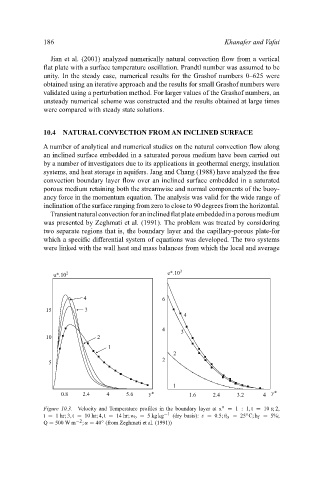
                             Transientnaturalconvectionforaninclinedflatplateembeddedinaporousmedium
                           was presented by Zeghmati et al. (1991). The problem was treated by considering
                           two separate regions that is, the boundary layer and the capillary-porous plate-for
                           which a specific differential system of equations was developed. The two systems
                           were linked with the wall heat and mass balances from which the local and average


                              u*.10 2                         e*.10 3


                                      4                      6
                            15         3
                                                                   4
                                                             4
                                                                  3
                            10            2
                                             1
                                                                2
                                                             2
                            5

                                                                1
                                0.8   2.4    4    5.6    y*         1.6    2.4    3.2    4  y*
                           Figure 10.3. Velocity and Temperature profiles in the boundary layer at x  ∗  = 1:1, t = 10 s; 2,
                                                                                    ◦
                           t = 1 hr; 3, t = 10 hr; 4, t = 14 hr; w o = 5kg kg −1  (dry basis): ε = 0.5; θ α = 25 C; h f = 5%;
                                           ◦
                           Q = 500 W m −2 ; α = 40 (from Zeghmati et al. (1991))

