


Page 297 - gas transport in porous media
P. 297
Chapter 17: Subsurface Flow Measurements
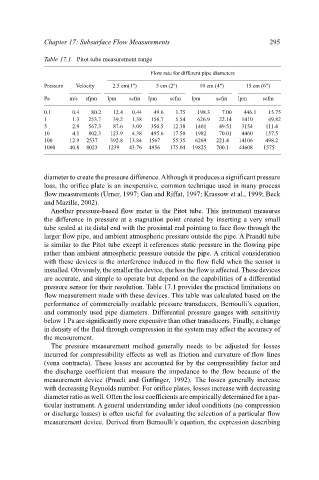
                           Table 17.1. Pitot tube measurement range
                                                         Flow rate for different pipe diameters  295
                           Pressure  Velocity  2.5 cm(1")  5 cm (2")   10 cm (4")   15 cm (6")
                           Pa     m/s  sfpm  lpm   scfm  lpm   scfm  lpm    scfm  lpm    scfm

                           0.1     0.4  80.2   12.4  0.44  49.6  1.75  198.3  7.00  446.1  15.75
                           1       1.3  253.7  39.2  1.38  156.7  5.54  626.9  22.14  1410  49.82
                           5       2.9  567.3  87.6  3.09  350.5  12.38  1401  49.51  3154  111.4
                           10      4.1  802.3  123.9  4.38  495.6  17.50  1982  70.01  4460  157.5
                           100    12.9  2537  392.8  13.84  1567  55.35  6269  221.4  14106  498.2
                           1000   40.8  8023  1239  43.76  4956  175.04  19825  700.1  44608  1575


                           diameter to create the pressure difference. Although it produces a significant pressure
                           loss, the orifice plate is an inexpensive, common technique used in many process
                           flow measurements (Urner, 1997; Gan and Riffat, 1997; Krassow et al., 1999; Beck
                           and Mazille, 2002).
                             Another pressure-based flow meter is the Pitot tube. This instrument measures
                           the difference in pressure at a stagnation point created by inserting a very small
                           tube sealed at its distal end with the proximal end pointing to face flow through the
                           larger flow pipe, and ambient atmospheric pressure outside the pipe. A Prandtl tube
                           is similar to the Pitot tube except it references static pressure in the flowing pipe
                           rather than ambient atmospheric pressure outside the pipe. A critical consideration
                           with these devices is the interference induced in the flow field when the sensor is
                           installed. Obviously, the smaller the device, the less the flow is affected. These devices
                           are accurate, and simple to operate but depend on the capabilities of a differential
                           pressure sensor for their resolution. Table 17.1 provides the practical limitations on
                           flow measurement made with these devices. This table was calculated based on the
                           performance of commercially available pressure transducers, Bernoulli’s equation,
                           and commonly used pipe diameters. Differential pressure gauges with sensitivity
                           below 1 Pa are significantly more expensive than other transducers. Finally, a change
                           in density of the fluid through compression in the system may affect the accuracy of
                           the measurement.
                             The pressure measurement method generally needs to be adjusted for losses
                           incurred for compressibility effects as well as friction and curvature of flow lines
                           (vena contracta). These losses are accounted for by the compressiblity factor and
                           the discharge coefficient that measure the impedance to the flow because of the
                           measurement device (Pnueli and Gutfinger, 1992). The losses generally increase
                           with decreasing Reynolds number. For orifice plates, losses increase with decreasing
                           diameter ratio as well. Often the loss coefficients are empirically determined for a par-
                           ticular instrument. A general understanding under ideal conditions (no compression
                           or discharge losses) is often useful for evaluating the selection of a particular flow
                           measurement device. Derived from Bernoulli’s equation, the expression describing

