


Page 302 - gas transport in porous media
P. 302
Rossabi
                           300
                           must be solved include long term and drift free operation. The drift problems are not
                           insurmountable, however, and if minimally invasive emplacement and data recovery
                           can be worked out, micro sensors will ultimately be installed for high resolution
                           measurements of subsurface flow behavior.

                           17.7  CONCLUSIONS

                           There are several technologies available for measuring subsurface gas flow depend-
                           ing on the desired application. Because of their small size, accuracy and simplicity,
                           Pitot tubes and thermal flow sensors are most often selected for precise flow field
                           measurements. Their inherent physical characteristics can be used to select the appro-
                           priate type of sensor for a particular application. For low fluid velocity applications
                           (< 1 m/sec), thermal sensors provide a strong dynamic response while Pitot tubes
                           produce a much weaker response because of the low differential pressure at that flow
                           rate. At high flow rates (> 15 m/sec) and correspondingly high differential pressure,
                           the Pitot tube is superior to a thermal flow sensor which has a lower sensitivity to
                           small changes in flow at those rates (Ismail and Davidian, 1999).
                             Other flow sensors may also be appropriate for measuring subsurface flow partic-
                           ularly in process-like applications. The user of these instruments must understand her
                           system and measurement objectives well enough to select the right sensor. Additional
                           information can be obtained from several national and international engineering and
                           standards organizations including the International Organization for Standards (ISO)
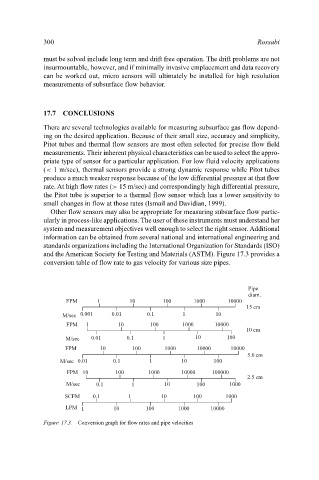
                           and the American Society for Testing and Materials (ASTM). Figure 17.3 provides a
                           conversion table of flow rate to gas velocity for various size pipes.


                                                                                     Pipe
                                                                                     diam.
                                 FPM      1        10        100      1000     10000
                                                                                    15 cm
                                M/sec  0.001  0.01      0.1       1         10
                                 FPM   1        10       100      1000      10000
                                                                                    10 cm
                                 M/sec   0.01      0.1       1        10       100
                                 FPM       10       100      1000     10000     10000
                                                                                     5.0 cm
                                M/sec  0.01    0.1       1        10       100
                                  FPM  10      100       1000     10000    100000
                                                                                     2.5 cm
                                 M/sec    0.1       1        10       100       1000
                                 SCFM    0.1       1        10       100       1000
                                 LPM  1        10       100      1000     10000

                           Figure 17.3.  Conversion graph for flow rates and pipe velocities

