


Page 301 - gas transport in porous media
P. 301
Chapter 17: Subsurface Flow Measurements


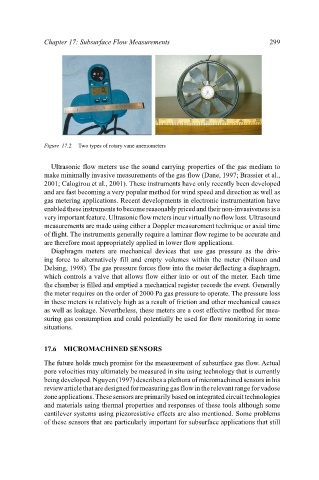
                           Figure 17.2. Two types of rotary vane anemometers               299

                             Ultrasonic flow meters use the sound carrying properties of the gas medium to
                           make minimally invasive measurements of the gas flow (Dane, 1997; Brassier et al.,
                           2001; Calogirou et al., 2001). These instruments have only recently been developed
                           and are fast becoming a very popular method for wind speed and direction as well as
                           gas metering applications. Recent developments in electronic instrumentation have
                           enabled these instruments to become reasonably priced and their non-invasiveness is a
                           veryimportantfeature. Ultrasonicflowmetersincurvirtuallynoflowloss. Ultrasound
                           measurements are made using either a Doppler measurement technique or axial time
                           of flight. The instruments generally require a laminar flow regime to be accurate and
                           are therefore most appropriately applied in lower flow applications.
                             Diaphragm meters are mechanical devices that use gas pressure as the driv-
                           ing force to alternatively fill and empty volumes within the meter (Nilsson and
                           Delsing, 1998). The gas pressure forces flow into the meter deflecting a diaphragm,
                           which controls a valve that allows flow either into or out of the meter. Each time
                           the chamber is filled and emptied a mechanical register records the event. Generally
                           the meter requires on the order of 2000 Pa gas pressure to operate. The pressure loss
                           in these meters is relatively high as a result of friction and other mechanical causes
                           as well as leakage. Nevertheless, these meters are a cost effective method for mea-
                           suring gas consumption and could potentially be used for flow monitoring in some
                           situations.


                           17.6  MICROMACHINED SENSORS
                           The future holds much promise for the measurement of subsurface gas flow. Actual
                           pore velocities may ultimately be measured in situ using technology that is currently
                           being developed. Nguyen (1997) describes a plethora of micromachined sensors in his
                           review article that are designed for measuring gas flow in the relevant range for vadose
                           zoneapplications. Thesesensorsareprimarilybasedonintegratedcircuittechnologies
                           and materials using thermal properties and responses of these tools although some
                           cantilever systems using piezoresistive effects are also mentioned. Some problems
                           of these sensors that are particularly important for subsurface applications that still

