


Page 327 - gas transport in porous media
P. 327
326
                                       1400
                                       1200                                              Tartre
                                       1000    Initial concentration
                                    Concentrations  (in ppm)  800

                                        600
                                        400
                                        200         B
                                          0
                                           0  1  2  3  4  5  6  7  0  1  2  3  4  5  6  7
                                                            Time (in minutes)
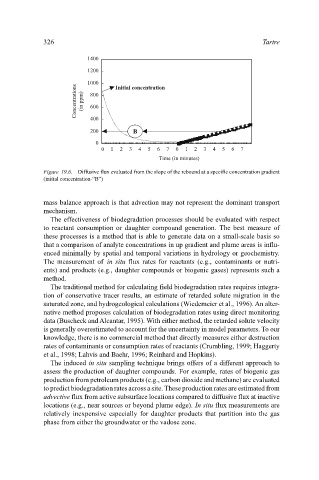
                           Figure 19.6.  Diffusive flux evaluated from the slope of the rebound at a specific concentration gradient
                           (initial concentration-“B”)


                           mass balance approach is that advection may not represent the dominant transport
                           mechanism.
                             The effectiveness of biodegradation processes should be evaluated with respect
                           to reactant consumption or daughter compound generation. The best measure of
                           these processes is a method that is able to generate data on a small-scale basis so
                           that a comparison of analyte concentrations in up gradient and plume areas is influ-
                           enced minimally by spatial and temporal variations in hydrology or geochemistry.
                           The measurement of in situ flux rates for reactants (e.g., contaminants or nutri-
                           ents) and products (e.g., daughter compounds or biogenic gases) represents such a
                           method.
                             The traditional method for calculating field biodegradation rates requires integra-
                           tion of conservative tracer results, an estimate of retarded solute migration in the
                           saturated zone, and hydrogeological calculations (Wiedemeier et al., 1996). An alter-
                           native method proposes calculation of biodegradation rates using direct monitoring
                           data (Buscheck and Alcantar, 1995). With either method, the retarded solute velocity
                           is generally overestimated to account for the uncertainty in model parameters. To our
                           knowledge, there is no commercial method that directly measures either destruction
                           rates of contaminants or consumption rates of reactants (Crumbling, 1999; Haggerty
                           et al., 1998; Lahvis and Baehr, 1996; Reinhard and Hopkins).
                             The induced in situ sampling technique brings offers of a different approach to
                           assess the production of daughter compounds. For example, rates of biogenic gas
                           production from petroleum products (e.g., carbon dioxide and methane) are evaluated
                           to predict biodegradation rates across a site. These production rates are estimated from
                           advective flux from active subsurface locations compared to diffusive flux at inactive
                           locations (e.g., near sources or beyond plume edge). In situ flux measurements are
                           relatively inexpensive especially for daughter products that partition into the gas
                           phase from either the groundwater or the vadose zone.

