


Page 147 - Geochemical Remote Sensing of The Sub-Surface
P. 147
124                                                               M. Zhang

           CASE HISTORIES

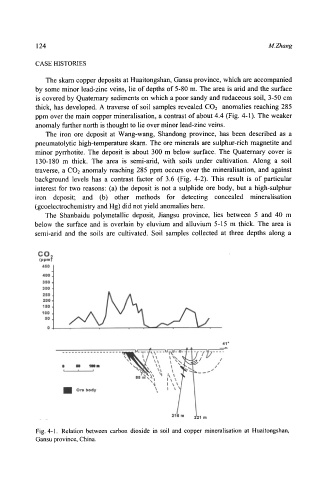
              The  skarn copper deposits at Huaitongshan,  Gansu province,  which  are  accompanied
           by some  minor lead-zinc veins,  lie of depths  of 5-80  m.  The  area  is arid and the  surface
           is covered by Quaternary  sediments on which  a poor sandy and rudaceous  soil,  3-50  cm
           thick,  has  developed.  A  traverse  of soil  samples  revealed  CO2  anomalies  reaching  285
           ppm over the main copper mineralisation, a contrast of about 4.4  (Fig. 4-1).  The  weaker
           anomaly further north is thought to lie over minor lead-zinc veins.
              The  iron  ore  deposit  at  Wang-wang,  Shandong  province,  has  been  described  as  a
           pneumatolytic high-temperature  skarn.  The  ore  minerals  are  sulphur-rich  magnetite  and
           minor  pyrrhotite.  The  deposit  is  about  300  m  below  surface.  The  Quaternary  cover  is
           130-180  m  thick.  The  area  is  semi-arid,  with  soils  under  cultivation.  Along  a  soil
           traverse,  a  CO2  anomaly  reaching  285  ppm  occurs  over  the  mineralisation,  and  against
           background  levels  has  a  contrast  factor  of  3.6  (Fig.  4-2).  This  result  is  of  particular
           interest  for  two  reasons:  (a)  the  deposit  is  not  a  sulphide  ore  body,  but  a  high-sulphur
           iron  deposit;  and  (b)  other  methods  for  detecting  concealed  mineralisation
           (geoelectrochemistry and Hg) did not yield anomalies here.
              The  Shanbaidu  polymetallic  deposit,  Jiangsu  province,  lies  between  5  and  40  m
           below  the  surface  and  is  overlain  by  eluvium  and  alluvium  5-15  m  thick.  The  area  is
           semi-arid  and  the  soils  are  cultivated.  Soil  samples  collected  at  three  depths  along  a


           Fig. 4-1.  Relation between  carbon  dioxide  in  soil and  copper  mineralisation  at  Huaitongshan,
           Gansu province, China.

