


Page 148 - Geochemical Remote Sensing of The Sub-Surface
P. 148
Carbon dioxide dispersion halos around mineral deposits               125

           traverse reveal broadly similar CO2 patterns  (Fig. 4-3).  In the centre of the traverse,  over
           the  mineral  deposit,  soils  from  30  and  60  em  exhibit  anomalies  reaching  400  ppm  CO2,
           whilst  anomalies  in  soils  from  100  cm  are  rather  weaker.  All  of these  anomalies  stand
           out  clearly  against  the  low  background  in  the  southern  part  of the  traverse,  where  the
           overburden  is eluvium.  However,  they have,  at best,  poor  contrast relative to the  higher
           background  in the northem part of the traverse, where the overburden  is alluvium.
              The  Qixiashan  lead-zinc  deposit  is  a  hydrothermal  lead-zinc  mineralisation  in  a
           cataclastic  fault  zone  in  limestone.  The  ore  body  is  300  m  below  surface,  and  the
           overburden  comprises  30 m of Quatemary alluvium.  Soil samples were collected  along a
           traverse  over the  mineralisation  in three  successive  years  and  analysed  for CO2  (Fig.  4-
           4).  The  samples  from  Year  1  yielded  the  highest  COz  concentrations  and  broadest
           anomaly,  but  contrast  is poor.  In Year 2 the  anomaly  is  about  200  ppm  CO2  and  is best
           developed  around  a fault that cuts the mineralisation  at depth.  Anomaly contrast  is put at
           4.2.  Samples  were taken  from a depth  of 80 cm  in Year  3,  compared  to  30  cm  in earlier
           years;  the  resulting  CO2  pattern,  however,  is  closely  similar  to  that  found  in  Year  2.
           Analysis  of  bore  hole  samples  for  CO2,  Hg,  Pb,  Zn,  Cu  and  Ag  showed  that  the
           Qixiashan  deposit  is  vertically  and  horizontally  zoned  (Fig.  4-5).  The  highest  COz
           concentrations  are  found  close  to  the  richest  ore.  The  CO2  halo  extends  upward  on  the
           hangingwall  side of the deposit and spreads  laterally. This halo is much better developed
           above  the  mineralisation  than  those  of the  base  and  precious  metals;  only  the  Hg  halo
           extends as far upward,  and it is also rather wider.


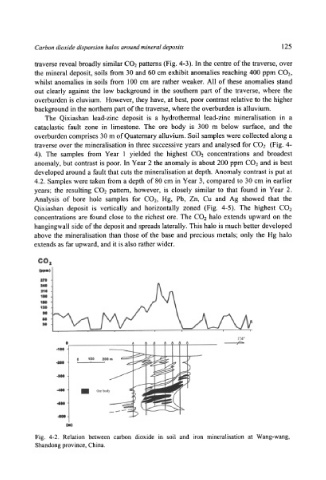
           Fig.  4-2. Relation  between  carbon  dioxide  in  soil  and  iron mineralisation  at  Wang-wang,
           Shandong province, China.

