


Page 149 - Geochemical Remote Sensing of The Sub-Surface
P. 149
126                                                               M.Zhang
             c02[              30  cm  soil  sampling depth
           (ppm)  ]
             400 l
             300 ]
             200 I


             C02               60  cm  soil  sampling depth
           (ppm)
             400
             300
             200
             100
               0
             C02              100  cm  soil  sampling  depth
           (ppm)
             400
             300
             200
             100
              0


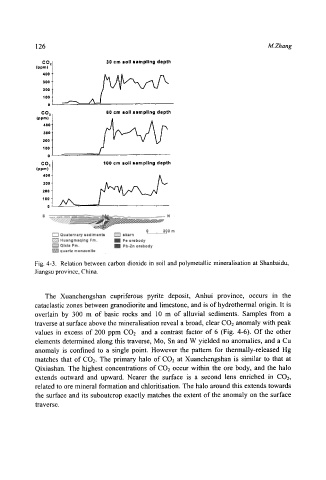
           Fig. 4-3.  Relation between carbon dioxide  in soil and polymetallic  mineralisation  at Shanbaidu,
           Jiangsu province, China.


              The  Xuanchengshan  cupriferous  pyrite  deposit,  Anhui  province,  occurs  in  the
           cataclastic zones between granodiorite and limestone, and  is of hydrothermal origin.  It is
           overlain  by  300  m  of  basic  rocks  and  10  m  of  alluvial  sediments.  Samples  from  a
           traverse at surface above the mineralisation reveal a broad,  clear CO2 anomaly with peak
           values  in  excess  of  200  ppm  CO2  and  a  contrast  factor  of  6  (Fig.  4-6).  Of  the  other
           elements determined  along this traverse,  Mo,  Sn  and  W  yielded no  anomalies,  and  a Cu
           anomaly  is  confined  to  a  single  point.  However  the  pattern  for  thermally-released  Hg
           matches  that  of CO2. The  primary  halo  of CO2  at  Xuanchengshan  is  similar  to  that  at
           Qixiashan.  The  highest  concentrations  of CO2  occur  within  the  ore  body,  and  the  halo
           extends  outward  and  upward.  Nearer  the  surface  is  a  second  lens  enriched  in  CO2,
           related to ore mineral  formation and chloritisation.  The halo  around  this extends towards
           the  surface  and  its suboutcrop  exactly matches  the  extent of the  anomaly on  the  surface
           traverse.

