


Page 152 - Geochemical Remote Sensing of The Sub-Surface
P. 152
Carbon dioxide dispersion halos around mineral deposits               129


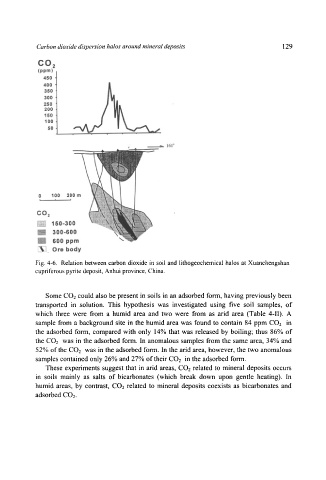
           Fig. 4-6.  Relation between carbon dioxide in soil and lithogeochemical  halos at Xuanchengshan
           cupriferous pyrite deposit, Anhui province, China.


              Some CO2 could also be present in soils in an adsorbed  form, having previously been
           transported  in  solution.  This  hypothesis  was  investigated  using  five  soil  samples,  of
           which  three  were  from  a  humid  area  and  two  were  from  as  arid  area  (Table  4-1I).  A
           sample  from  a background  site  in the  humid  area  was  found  to  contain  84  ppm  CO2  in
           the  adsorbed  form,  compared  with  only  14%  that  was  released  by boiling;  thus  86%  of
           the CO2  was  in the adsorbed  form.  In anomalous  samples  from the  same  area,  34%  and
           52% of the CO2  was  in the adsorbed  form.  In the arid area, however,  the two anomalous
           samples contained only 26% and 27% of their CO2  in the adsorbed  form.
              These  experiments  suggest that  in  arid  areas,  CO2  related  to  mineral  deposits  occurs
           in  soils  mainly  as  salts  of  bicarbonates  (which  break  down  upon  gentle  heating).  In
           humid  areas,  by  contrast,  CO2  related  to  mineral  deposits  coexists  as  bicarbonates  and
           adsorbed CO2.

