


Page 150 - Geochemical Remote Sensing of The Sub-Surface
P. 150
Carbon dioxide dispersion halos around mineral deposits               127

                 Year  1  (30  cm  soil  sampling  depth)
            ,.., 400
            E
            Q.  300
              200
            O"  lOO
            (,..1
               0    ,    9   '    9   .  .  .  .
            "~   Year  2  (30  cm  soil  sampling  depth)
            n.  250
            n.  200
            ""  160
                    ,   ,    ,   ,    ,    ,   ,
            A    Year  3  (80  cm  soil  sampling  depth)
            E  2so
            Q"  200
              15o
            .  100
            0   6O
            (.)   0


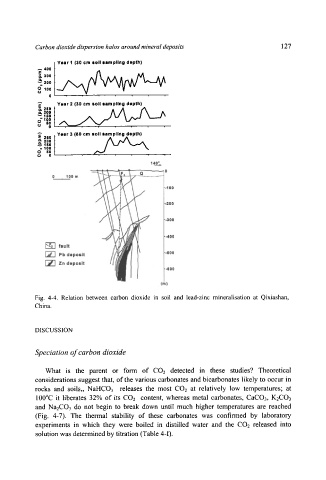
           Fig.  4-4. Relation between carbon dioxide in  soil and  lead-zinc mineralisation  at  Qixiashan,
           China.


           DISCUSSION


           Speciation  of carbon  dioxide

              What  is  the  parent  or  form  of  CO2  detected  in  these  studies?  Theoretical
           considerations  suggest that,  of the various carbonates and bicarbonates  likely to occur in
           rocks  and  soils,,  NaHCO3  releases  the  most  CO2  at  relatively  low  temperatures;  at
           100~  it  liberates  32%  of its  CO2  content,  whereas  metal  carbonates,  CaCO3,  K2CO3
           and  NazCO3  do  not  begin  to  break  down  until  much  higher  temperatures  are  reached
           (Fig.  4-7).  The  thermal  stability  of  these  carbonates  was  confirmed  by  laboratory
           experiments  in  which  they  were  boiled  in  distilled  water  and  the  CO2  released  into
           solution was determined by titration (Table 4-I).

