


Page 168 - Geochemical Remote Sensing of The Sub-Surface
P. 168
Light hydrocarbons for petroleum and gas prospecting                 145

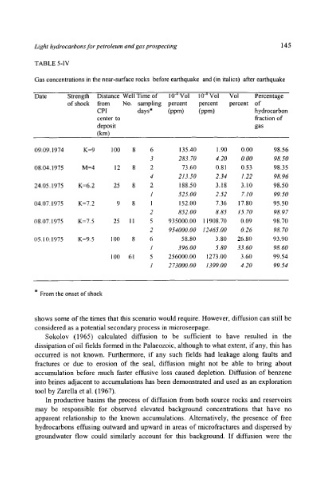
           TABLE 5-IV
           Gas concentrations in the near-surface rocks  before earthquake  and (in italics)  after earthquake

           Date     Strength   Distance  Well Time of   10 4 Vol   10 -4 Vol   Vol   Percentage
                    of shock  from   No.  sampling  percent   percent   percent  of
                             CPI        days*    (ppm)   (ppm)           hydrocarbon
                             center to                                   fraction of
                             deposit                                     gas
                             (km)

           09.09.1974    K=9     100   8    6       135.40    1.90   0.00     98.56
                                            3       283.70    4.20   0.00     98.50
           08.04.1975   M=4       12   8    2        73.60    0.81   0.53     98.35
                                            4       213.50    2.34   1.22     98.96
           24.05.1975   K=6.2    25    8    2       188.50    3.18   3. ! 0   98.50
                                            1       525.00    2.52   7.10     99.50
           04.07.1975   K=7.2     9   8     1       152.00    7.36   17.80    95.50
                                           2        852.00    8.85   15.70    98.97
           08.07.1975   K=7.5    25   11   5     935000.00  11908.70   0.09   98.70
                                           2     954000.00   12465.00   0.26   98.70
           05.10.1975   K=9.5    100   8   6        58.80     3.80   26.80    93.90
                                            1      396.00     5.80   33.60    98.60
                                 100   61   5    256000.00   1273.00   3.60   99.54
                                            !    273000.00   1399.00   4.20   99.54


           :g
             From the onset of shock


           shows  some of the times  that this  scenario  would require.  However,  diffusion can still  be
           considered as a potential  secondary process  in microseepage.
              Sokolov  (1965)  calculated  diffusion  to  be  sufficient  to  have  resulted  in  the
           dissipation  of oil fields  formed in the Palaeozoic,  although to what extent,  if any,  this has
           occurred  is  not  known.  Furthermore,  if  any  such  fields  had  leakage  along  faults  and
           fractures  or  due  to  erosion  of  the  seal,  diffusion  might  not  be  able  to  bring  about
           accumulation  before  much  faster  effusive  loss  caused  depletion.  Diffusion  of benzene
           into  brines  adjacent  to  accumulations  has  been  demonstrated  and  used  as  an  exploration
           tool by Zarella et al.  (1967).
              In  productive  basins  the  process  of diffusion  from both  source  rocks  and  reservoirs
           may  be  responsible  for  observed  elevated  background  concentrations  that  have  no
           apparent  relationship  to  the  known  accumulations.  Alternatively,  the  presence  of  free
           hydrocarbons  effusing  outward  and  upward  in  areas  of microfractures  and  dispersed  by
           groundwater  flow  could  similarly  account  for  this  background.  If  diffusion  were  the

