


Page 169 - Geochemical Remote Sensing of The Sub-Surface
P. 169
146                                     V.T. Jones,  M.D.  Matthews and D.M.  Richers
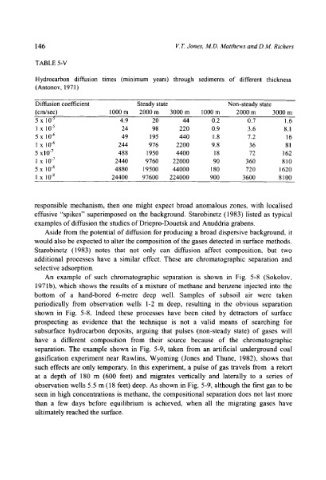
           TABLE 5-V

           Hydrocarbon  diffusion  times  (minimum  years)  through  sediments  of  different  thickness
           (Antonov,  1971 )

           Diffusion coefficient        Steady state             Non-steady state
           (crn/sec)            1000 m   2000 m   3000 m   1000 m   2000 m    3000 m
           5 x  10 -5              4.9      20       44      0.2       0.7       1.6
           1 x 10 .5                24      98      220      0.9       3.6       8. I
           5 x  10 -6               49     195      440      1.8       7.2        16
           1 x  10 .6              244     976     2200      9.8       36         81
           5 x 10 .7               488    1950     4400       18       72        162
           1 x  10 .7             2440    9760    22000      90       360        810
           5 x 10 .8              4880    19500   44000      180      720       1620
           1 x  10 -8            24400   97600   224000     900       3600      8100


           responsible  mechanism,  then  one  might  expect  broad  anomalous  zones,  with  localised
           effusive  "spikes"  superimposed  on  the  background.  Starobinetz  (1983)  listed  as  typical
           examples of diffusion the  studies of Driepro-Douetsk  and Anuddria  grabens.
              Aside  from the potential  of diffusion  for producing  a  broad  dispersive  background,  it
           would  also be expected to alter the composition of the gases detected  in surface  methods.
           Starobinetz  (1983)  notes  that  not  only  can  diffusion  affect  composition,  but  two
           additional  processes  have  a  similar  effect.  These  are  chromatographic  separation  and
           selective adsorption.
              An  example  of  such  chromatographic  separation  is  shown  in  Fig.  5-8  (Sokolov,
           197 lb),  which  shows  the  results  of a  mixture  of methane  and  benzene  injected  into  the
           bottom  of  a  hand-bored  6-metre  deep  well.  Samples  of  subsoil  air  were  taken
           periodically  from  observation  wells  1-2  m  deep,  resulting  in  the  obvious  separation
           shown  in  Fig.  5-8.  Indeed  these  processes  have  been  cited  by  detractors  of  surface
           prospecting  as  evidence  that  the  technique  is  not  a  valid  means  of  searching  for
           subsurface  hydrocarbon  deposits,  arguing  that  pulses  (non-steady  state)  of  gases  will
           have  a  different  composition  from  their  source  because  of  the  chromatographic
           separation.  The  example  shown  in  Fig.  5-9,  taken  from  an  artificial  underground  coal
           gasification  experiment  near  Rawlins,  Wyoming  (Jones  and  Thune,  1982),  shows  that
           such  effects  are  only  temporary.  In this  experiment,  a  pulse  of gas  travels  from  a  retort
           at  a  depth  of  180  m  (600  feet)  and  migrates  vertically  and  laterally  to  a  series  of
           observation wells 5.5  m (18  feet) deep.  As shown  in Fig.  5-9,  although the  first gas to  be
           seen  in high  concentrations  is methane,  the  compositional  separation  does  not  last  more
           than  a  few  days  before  equilibrium  is  achieved,  when  all  the  migrating  gases  have
           ultimately reached the surface.

