


Page 170 - Geochemical Remote Sensing of The Sub-Surface
P. 170
Light hydrocarbons for petroleum and gas prospecting                  147

                                                       Key
                                                     CH 4
                                                     ZHC

               CH  4  Y'HC  vol%        CH  4  ]~HC  10 -4  voi  %
              30  I-  o.3o I--
                  0.25                 1000        Well
             26   ).20                  600
                  D.15    .-,--,-  ,..-,"  200   12            ".
             22   ).10   Ir   i   _     J     4   it   i  i  i  i  t  t  !  I  I  I  I  I
               I'"I::-,-:"~ ,;:
             60   CH  4                  CH 4   Y'HCl0  "4  vol%   I  /
             40                          o,    /       K-T
                                      i  ~ f   shY,  ,..';.i  j
             20                          0.5                 /
                                                              ,  ,...,  ,
                                         o.4
                                        I
               c.,  Z.c~0 "4 vo. %  $ ~   c.  z.c~0  4vo, %
                                        ,,o       w.,
                10"40[  ..   ~   1. I  "-~'I   140   /      /I  ~
             30          ~   ""  -"     100   10  8
                /~  f -         I        ~o   ~r-       "~"'-
                L-   !   I   I   !   t   t   I   I   I   !   I  60   It   I  !  I!ll   II   I  !  I  I
               CH  4  y" HC 10 .4  vol  %   CH 4  T'HC  10 .4  vol  %
            1000                          5   0.4   Well  79   I
                       Well  104   l /
             800
            600                           4  3   0.3
            400                           2   0.2
            200    5              ~J~     1
                   31-  t   t  -Fi   i   !   i   t   i   J   I  i  i  i  I  I  I  I  I   I  I  !  I
                     10   20   30  5   15       27  31  3   16   25   5   15
                    September   October        August   September   October

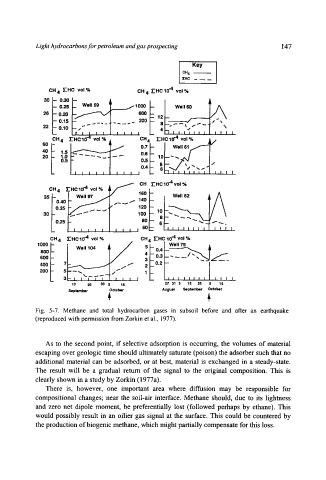
           Fig.  5-7.  Methane  and  total hydrocarbon  gases  in  subsoil before  and  after  an  earthquake
           (reproduced with permission from Zorkin et al., 1977).


              As  to  the  second  point,  if selective  adsorption  is  occurring,  the  volumes  of material
           escaping over geologic time should ultimately saturate (poison)  the adsorber such that no
           additional  material  can  be  adsorbed,  or at best,  material  is  exchanged  in  a  steady-state.
           The  result  will  be  a  gradual  return  of  the  signal  to  the  original  composition.  This  is
           clearly shown in a study by Zorkin (1977a).
              There  is,  however,  one  important  area  where  diffusion  may  be  responsible  for
           compositional  changes;  near  the  soil-air  interface.  Methane  should,  due  to  its  lightness
           and  zero  net  dipole  moment,  be  preferentially  lost  (followed  perhaps  by  ethane).  This
           would  possibly  result  in  an  oilier  gas  signal  at  the  surface.  This  could  be  countered  by
           the production  ofbiogenic  methane, which might partially compensate  for this loss.

