


Page 171 - Geochemical Remote Sensing of The Sub-Surface
P. 171
148                                     V.T. Jones,  M.D.  Matthews and D.M.  Richers


               0.1


                0              I    .......  i         i
                   0           5          10          15
                                 Time  (days)
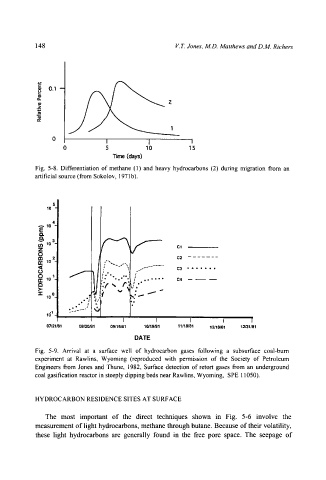
           Fig. 5-8. Differentiation  of methane  (1)  and  heavy  hydrocarbons  (2)  during  migration  from  an
           artificial  source (from Sokolov,  1971b).


              10  5_

              10 4 -
            E
            I~.
            ~'IO  3-
                                                   Cl   ,,
                                                   C2
                                       Ioo.......--'- ....   C3   ,~176176176
                                       I   oO  o  oo~   C4
                     .::.-'.;'
              10 0

              ld 1 .
                 u                                     I        I       I
              07/21/81   08120/81   09/19181   10/19/81   11118181   12/18/81   12131/81
                                       DATE
           Fig.  5-9. Arrival  at  a  surface  well of  hydrocarbon  gases  following  a  subsurface  coal-bum
           experiment  at  Rawlins,  Wyoming  (reproduced  with  permission  of  the  Society  of  Petroleum
           Engineers  from Jones  and  Thune,  1982, Surface  detection  of retort  gases  from an  underground
           coal gasification reactor in steeply dipping beds near Rawlins, Wyoming,  SPE  11050).


           HYDROCARBON RESIDENCE SITES AT SURFACE

              The  most  important  of  the  direct  techniques  shown  in  Fig.  5-6  involve  the
           measurement of light hydrocarbons,  methane  through butane.  Because  of their volatility,
           these  light  hydrocarbons  are  generally  found  in  the  free  pore  space.  The  seepage  of

