


Page 223 - Geochemical Remote Sensing of The Sub-Surface
P. 223
Light hydrocarbons jbr petroleum and gas prospecting                  199


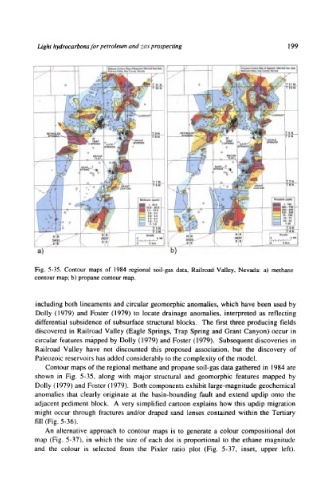
           Fig. 5-35. Contour maps of  1984 regional soil-gas data, Railroad Valley, Nevada: a)  methane
           contour map; b) propane contour map.


           including both  lineaments and circular  geomorphic  anomalies,  which  have  been  used by
           Dolly  (1979)  and  Foster  (1979)  to  locate  drainage  anomalies,  interpreted  as  reflecting
           differential  subsidence  of subsurface  structural  blocks.  The  first  three  producing  fields
           discovered  in  Railroad  Valley  (Eagle  Springs, Trap  Spring and  Grant  Canyon)  occur  in
           circular features  mapped  by Dolly (1979)  and  Foster (1979).  Subsequent discoveries  in
           Railroad  Valley  have  not  discounted  this  proposed  association,  but  the  discovery  of
           Paleozoic reservoirs has added considerably to the complexity of the model.
              Contour maps of the regional methane and propane soil-gas data gathered  in  1984 are
           shown  in  Fig.  5-35,  along  with  major  structural  and  geomorphic  features  mapped  by
           Dolly (1979) and Foster (1979).  Both components exhibit  large-magnitude  geochemical
           anomalies  that  clearly  originate  at  the  basin-bounding  fault  and  extend  updip  onto  the
           adjacent  pediment  block.  A  very simplified  cartoon  explains  how  this  updip  migration
           might  occur  through  fractures  and/or  draped  sand  lenses  contained  within  the  Tertiary
           fill (Fig. 5-36).
              An  alternative  approach  to  contour  maps  is  to  generate  a  colour  compositional  dot
           map  (Fig.  5-37),  in  which  the  size  of each  dot  is  proportional  to  the  ethane  magnitude
           and  the  colour  is  selected  from  the  Pixler  ratio  plot  (Fig.  5-37,  inset,  upper  left).

