


Page 224 - Geochemical Remote Sensing of The Sub-Surface
P. 224
200                         V. 7". Jones,  M.D.  Matthews  and D.  Richers


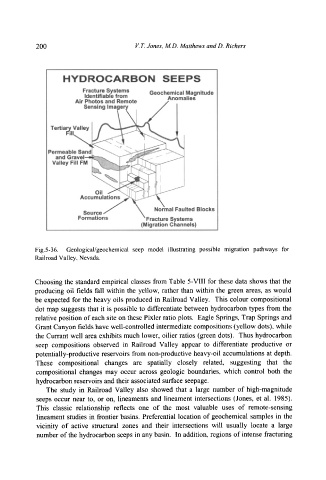
           Fig.5-36.  Geological/geochemical seep model illustrating possible migration pathways for
           Railroad Valley, Nevada.


           Choosing the standard empirical  classes  from Table  5-VIII for these data shows that the
           producing oil  fields fall  within the  yellow,  rather  than  within the  green  areas,  as would
           be expected  for the  heavy oils produced  in Railroad Valley.  This  colour compositional
           dot map  suggests that it is possible to differentiate  between hydrocarbon types from the
           relative position of each site on these Pixler ratio plots.  Eagle Springs, Trap  Springs and
           Grant Canyon fields have well-controlled intermediate compositions (yellow dots), while
           the Currant well area exhibits much lower,  oilier ratios (green dots).  Thus  hydrocarbon
           seep  compositions  observed  in  Railroad  Valley  appear  to  differentiate  productive  or
           potentially-productive reservoirs from non-productive heavy-oil accumulations at depth.
           These  compositional  changes  are  spatially  closely  related,  suggesting  that  the
           compositional  changes  may  occur  across  geologic  boundaries,  which  control  both  the
           hydrocarbon reservoirs and their associated surface seepage.
              The  study  in  Railroad  Valley  also  showed  that  a  large  number  of high-magnitude
           seeps  occur  near  to,  or  on,  lineaments  and  lineament  intersections  (Jones,  et  al.  1985).
           This  classic  relationship  reflects  one  of  the  most  valuable  uses  of  remote-sensing
           lineament  studies  in frontier basins.  Preferential  location of geochemical  samples  in the
           vicinity  of  active  structural  zones  and  their  intersections  will  usually  locate  a  large
           number of the hydrocarbon seeps in any basin.  In addition, regions of intense fracturing

