


Page 290 -
P. 290
261
                                                                G
                                                  C C h a p t e r   1 3 :  h a p t e r   1 3 :    G r e e n i n g   Yo u r   I n f o r m a t i o n   S y s t e m s  r e e n i n g   Yo u r   I n f o r m a t i o n   S y s t e m s    261

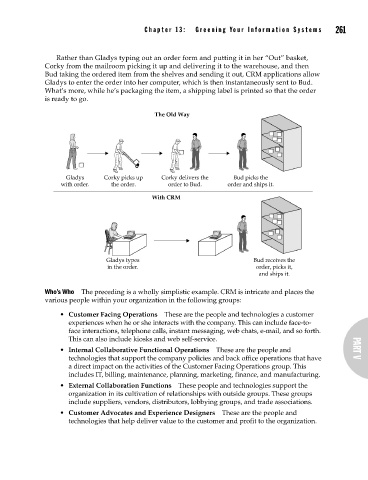
                         Rather than Gladys typing out an order form and putting it in her “Out” basket,
                      Corky from the mailroom picking it up and delivering it to the warehouse, and then
                      Bud taking the ordered item from the shelves and sending it out, CRM applications allow
                      Gladys to enter the order into her computer, which is then instantaneously sent to Bud.
                      What’s more, while he’s packaging the item, a shipping label is printed so that the order
                      is ready to go.

                                                     The Old Way


                            Gladys    Corky picks up   Corky delivers the  Bud picks the
                          with order.   the order.      order to Bud.    order and ships it.

                                                    With CRM


                                       Gladys types                             Bud receives the
                                       in the order.                             order, picks it,
                                                                                  and ships it.

                      Who’s Who  The preceding is a wholly simplistic example. CRM is intricate and places the
                      various people within your organization in the following groups:

                          •  Customer Facing Operations  These are the people and technologies a customer
                             experiences when he or she interacts with the company. This can include face-to-
                             face interactions, telephone calls, instant messaging, web chats, e-mail, and so forth.
                             This can also include kiosks and web self-service.
                          •  Internal Collaborative Functional Operations  These are the people and         PART V
                             technologies that support the company policies and back office operations that have
                             a direct impact on the activities of the Customer Facing Operations group. This
                             includes IT, billing, maintenance, planning, marketing, finance, and manufacturing.
                          •  External Collaboration Functions  These people and technologies support the
                             organization in its cultivation of relationships with outside groups. These groups
                             include suppliers, vendors, distributors, lobbying groups, and trade associations.
                          •  Customer Advocates and Experience Designers  These are the people and
                             technologies that help deliver value to the customer and profit to the organization.

