


Page 431 - Handbook Of Integral Equations
P. 431
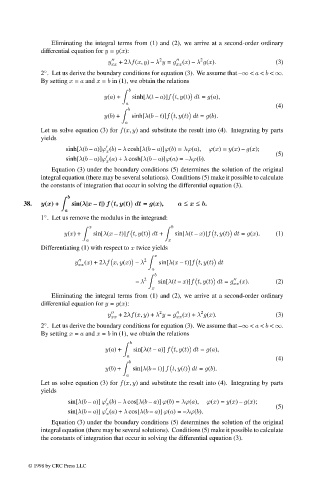
Eliminating the integral terms from (1) and (2), we arrive at a second-order ordinary
                     differential equation for y = y(x):
                                                         2
                                                                     2

                                         y     +2λf(x, y) – λ y = g (x) – λ g(x).           (3)
                                                              xx
                                          xx
                      ◦
                     2 . Let us derive the boundary conditions for equation (3). We assume that –∞ < a < b < ∞.
                     By setting x = a and x = b in (1), we obtain the relations
                                               b


                                        y(a)+   sinh[λ(t – a)]f t, y(t) dt = g(a),
                                              a                                             (4)
                                               b


                                        y(b)+   sinh[λ(b – t)]f t, y(t) dt = g(b).
                                              a
                     Let us solve equation (3) for f(x, y) and substitute the result into (4). Integrating by parts
                     yields

                            sinh[λ(b – a)]ϕ (b) – λ cosh[λ(b – a)]ϕ(b)= λϕ(a),  ϕ(x)= y(x) – g(x);
                                        x
                                                                                            (5)
                            sinh[λ(b – a)]ϕ (a)+ λ cosh[λ(b – a)]ϕ(a)= –λϕ(b).

                                        x
                        Equation (3) under the boundary conditions (5) determines the solution of the original
                     integral equation (there may be several solutions). Conditions (5) make it possible to calculate
                     the constants of integration that occur in solving the differential equation (3).
                               b

               38.   y(x)+    sin(λ|x – t|) f t, y(t) dt = g(x),  a ≤ x ≤ b.
                            a
                      ◦
                     1 . Let us remove the modulus in the integrand:
                                   x                        b


                            y(x)+    sin[λ(x – t)]f t, y(t) dt +  sin[λ(t – x)]f t, y(t) dt = g(x).  (1)
                                  a                        x
                     Differentiating (1) with respect to x twice yields
                                                        x
                                                    2

                               y (x)+2λf x, y(x) – λ    sin[λ(x – t)]f t, y(t) dt
                                xx
                                                      a
                                                        b


                                                 – λ 2  sin[λ(t – x)]f t, y(t) dt = g (x).  (2)

                                                                               xx
                                                      x
                        Eliminating the integral terms from (1) and (2), we arrive at a second-order ordinary
                     differential equation for y = y(x):
                                                                     2
                                                         2

                                         y      +2λf(x, y)+ λ y = g (x)+ λ g(x).            (3)
                                          xx                  xx
                     2 . Let us derive the boundary conditions for equation (3). We assume that –∞ < a < b < ∞.
                      ◦
                     By setting x = a and x = b in (1), we obtain the relations
                                                b


                                        y(a)+    sin[λ(t – a)] f t, y(t) dt = g(a),
                                               a
                                               b                                            (4)


                                        y(b)+    sin[λ(b – t)] f t, y(t) dt = g(b).
                                               a
                     Let us solve equation (3) for f(x, y) and substitute the result into (4). Integrating by parts
                     yields

                             sin[λ(b – a)] ϕ (b) – λ cos[λ(b – a)] ϕ(b)= λϕ(a),  ϕ(x)= y(x) – g(x);
                                        x
                                                                                            (5)

                             sin[λ(b – a)] ϕ (a)+ λ cos[λ(b – a)] ϕ(a)= –λϕ(b).
                                        x
                        Equation (3) under the boundary conditions (5) determines the solution of the original
                     integral equation (there may be several solutions). Conditions (5) make it possible to calculate
                     the constants of integration that occur in solving the differential equation (3).
                 © 1998 by CRC Press LLC
                © 1998 by CRC Press LLC
                                                                                                             Page 411

