


Page 433 - Handbook Of Integral Equations
P. 433
b

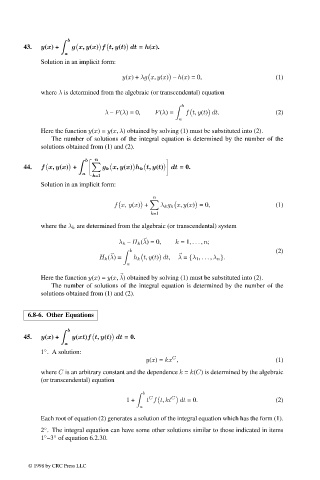
               43.   y(x)+    g x, y(x) f t, y(t) dt = h(x).
                            a
                     Solution in an implicit form:


                                             y(x)+ λg x, y(x) – h(x)=0,                     (1)
                     where λ is determined from the algebraic (or transcendental) equation
                                                               b


                                        λ – F(λ)=0,    F(λ)=     f t, y(t) dt.              (2)
                                                               a
                     Here the function y(x)= y(x, λ) obtained by solving (1) must be substituted into (2).
                        The number of solutions of the integral equation is determined by the number of the
                     solutions obtained from (1) and (2).

                                     n
                                  b
               44.   f x, y(x) +       g k x, y(x) h k t, y(t)  dt =0.
                                 a
                                    k=1
                     Solution in an implicit form:
                                                       n


                                           f x, y(x) +   λ k g k x, y(x) = 0,               (1)
                                                      k=1
                     where the λ k are determined from the algebraic (or transcendental) system

                                                    %
                                            λ k – H k (λ)=0,  k =1, ... , n;
                                                b
                                                                                            (2)
                                          %


                                      H k (λ)=   h k t, y(t) dt,  %
                                                              λ = {λ 1 , ... , λ n }.
                                               a
                                            %
                     Here the function y(x)= y(x, λ) obtained by solving (1) must be substituted into (2).
                        The number of solutions of the integral equation is determined by the number of the
                     solutions obtained from (1) and (2).
                 6.8-6. Other Equations

                             b


               45.   y(x)+    y(xt)f t, y(t) dt =0.
                            a
                      ◦
                     1 . A solution:
                                                             C
                                                     y(x)= kx ,                             (1)
                     where C is an arbitrary constant and the dependence k = k(C) is determined by the algebraic
                     (or transcendental) equation
                                                     b
                                                     C

                                               1+    t f t, kt C    dt = 0.                 (2)
                                                   a
                     Each root of equation (2) generates a solution of the integral equation which has the form (1).
                      ◦
                     2 . The integral equation can have some other solutions similar to those indicated in items
                         ◦
                      ◦
                     1 –3 of equation 6.2.30.

                 © 1998 by CRC Press LLC


                © 1998 by CRC Press LLC
                                                                                                             Page 413

