


Page 338 - Handbook of Materials Failure Analysis
P. 338
11 Babbitt Alloy Wear Particles  335


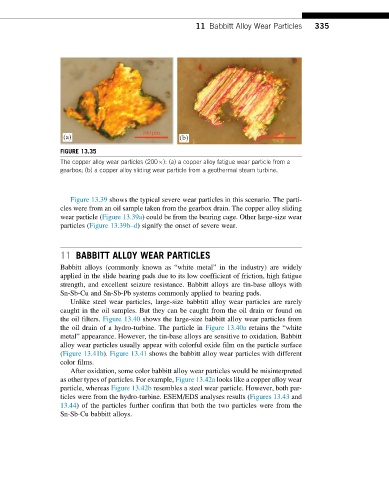
                                         100µm                              50µm
                   (a)                             (b)
                  FIGURE 13.35
                  The copper alloy wear particles (200 ): (a) a copper alloy fatigue wear particle from a
                  gearbox; (b) a copper alloy sliding wear particle from a geothermal steam turbine.


                     Figure 13.39 shows the typical severe wear particles in this scenario. The parti-
                  cles were from an oil sample taken from the gearbox drain. The copper alloy sliding
                  wear particle (Figure 13.39a) could be from the bearing cage. Other large-size wear
                  particles (Figure 13.39b–d) signify the onset of severe wear.


                  11 BABBITT ALLOY WEAR PARTICLES
                  Babbitt alloys (commonly known as “white metal” in the industry) are widely
                  applied in the slide bearing pads due to its low coefficient of friction, high fatigue
                  strength, and excellent seizure resistance. Babbitt alloys are tin-base alloys with
                  Sn-Sb-Cu and Sn-Sb-Pb systems commonly applied to bearing pads.
                     Unlike steel wear particles, large-size babbtitt alloy wear particles are rarely
                  caught in the oil samples. But they can be caught from the oil drain or found on
                  the oil filters. Figure 13.40 shows the large-size babbitt alloy wear particles from
                  the oil drain of a hydro-turbine. The particle in Figure 13.40a retains the “white
                  metal” appearance. However, the tin-base alloys are sensitive to oxidation. Babbitt
                  alloy wear particles usually appear with colorful oxide film on the particle surface
                  (Figure 13.41b). Figure 13.41 shows the babbitt alloy wear particles with different
                  color films.
                     After oxidation, some color babbitt alloy wear particles would be misinterpreted
                  as other types of particles. For example, Figure 13.42a looks like a copper alloy wear
                  particle, whereas Figure 13.42b resembles a steel wear particle. However, both par-
                  ticles were from the hydro-turbine. ESEM/EDS analyses results (Figures 13.43 and
                  13.44) of the particles further confirm that both the two particles were from the
                  Sn-Sb-Cu babbitt alloys.

