


Page 339 - Handbook of Materials Failure Analysis
P. 339
336    CHAPTER 13 A concise filtergram wear particle atlas


                                              100µm                              50µm
                          (a)                              (b)


                                                100µm                              100µm
                          (c)                              (d)

                         FIGURE 13.36
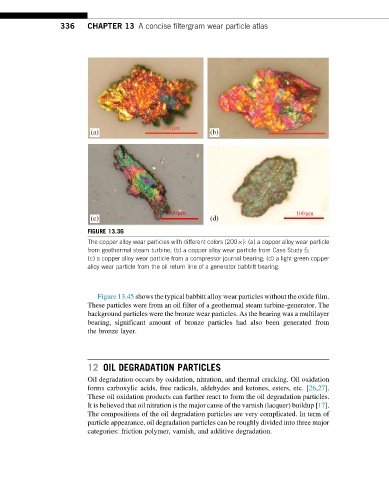
                         The copper alloy wear particles with different colors (200 ): (a) a copper alloy wear particle
                         from geothermal steam turbine; (b) a copper alloy wear particle from Case Study 5;
                         (c) a copper alloy wear particle from a compressor journal bearing; (d) a light-green copper
                         alloy wear particle from the oil return line of a generator babbitt bearing.


                            Figure 13.45 shows the typical babbitt alloy wear particles without the oxide film.
                         These particles were from an oil filter of a geothermal steam turbine-generator. The
                         background particles were the bronze wear particles. As the bearing was a multilayer
                         bearing, significant amount of bronze particles had also been generated from
                         the bronze layer.


                         12 OIL DEGRADATION PARTICLES
                         Oil degradation occurs by oxidation, nitration, and thermal cracking. Oil oxidation
                         forms carboxylic acids, free radicals, aldehydes and ketones, esters, etc. [26,27].
                         These oil oxidation products can further react to form the oil degradation particles.
                         It is believed that oil nitration is the major cause of the varnish (lacquer) buildup [17].
                         The compositions of the oil degradation particles are very complicated. In term of
                         particle appearance, oil degradation particles can be roughly divided into three major
                         categories: friction polymer, varnish, and additive degradation.

