


Page 343 - Handbook of Materials Failure Analysis
P. 343
340    CHAPTER 13 A concise filtergram wear particle atlas


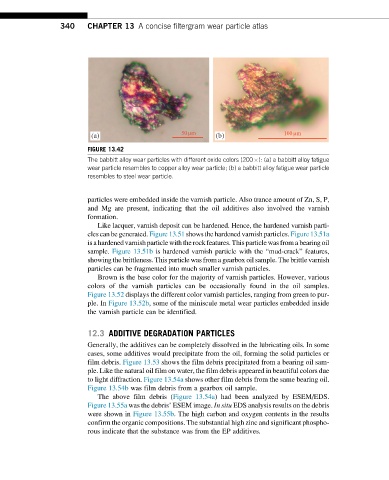
                          (a)                      50µm      (b)                100µm
                         FIGURE 13.42
                         The babbitt alloy wear particles with different oxide colors (200 ): (a) a babbitt alloy fatigue
                         wear particle resembles to copper alloy wear particle; (b) a babbitt alloy fatigue wear particle
                         resembles to steel wear particle.


                         particles were embedded inside the varnish particle. Also trance amount of Zn, S, P,
                         and Mg are present, indicating that the oil additives also involved the varnish
                         formation.
                            Like lacquer, varnish deposit can be hardened. Hence, the hardened varnish parti-
                         cles can be generated. Figure 13.51 shows the hardened varnish particles. Figure 13.51a
                         isa hardenedvarnishparticlewith the rock features. Thisparticlewas froma bearing oil
                         sample. Figure 13.51b is hardened varnish particle with the “mud-crack” features,
                         showing the brittleness. This particle was from a gearbox oil sample. The brittle varnish
                         particles can be fragmented into much smaller varnish particles.
                            Brown is the base color for the majority of varnish particles. However, various
                         colors of the varnish particles can be occasionally found in the oil samples.
                         Figure 13.52 displays the different color varnish particles, ranging from green to pur-
                         ple. In Figure 13.52b, some of the miniscule metal wear particles embedded inside
                         the varnish particle can be identified.

                         12.3 ADDITIVE DEGRADATION PARTICLES
                         Generally, the additives can be completely dissolved in the lubricating oils. In some
                         cases, some additives would precipitate from the oil, forming the solid particles or
                         film debris. Figure 13.53 shows the film debris precipitated from a bearing oil sam-
                         ple. Like the natural oil film on water, the film debris appeared in beautiful colors due
                         to light diffraction. Figure 13.54a shows other film debris from the same bearing oil.
                         Figure 13.54b was film debris from a gearbox oil sample.
                            The above film debris (Figure 13.54a) had been analyzed by ESEM/EDS.
                         Figure 13.55a was the debris’ ESEM image. In situ EDS analysis results on the debris
                         were shown in Figure 13.55b. The high carbon and oxygen contents in the results
                         confirm the organic compositions. The substantial high zinc and significant phospho-
                         rous indicate that the substance was from the EP additives.

