


Page 342 - Handbook of Materials Failure Analysis
P. 342
12 Oil Degradation Particles  339


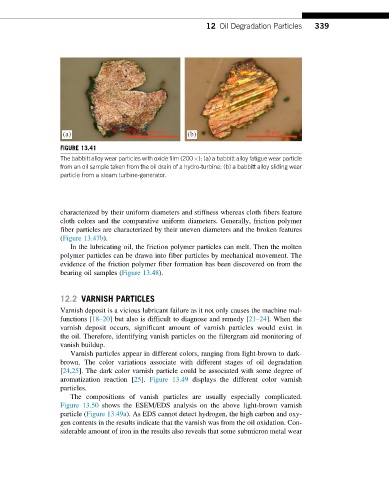
                  (a)                     500µm      (b)                   50µm
                  FIGURE 13.41
                  The babbitt alloy wear particles with oxide film (200 ): (a) a babbitt alloy fatigue wear particle
                  from an oil sample taken from the oil drain of a hydro-turbine; (b) a babbitt alloy sliding wear
                  particle from a steam turbine-generator.


                  characterized by their uniform diameters and stiffness whereas cloth fibers feature
                  cloth colors and the comparative uniform diameters. Generally, friction polymer
                  fiber particles are characterized by their uneven diameters and the broken features
                  (Figure 13.47b).
                     In the lubricating oil, the friction polymer particles can melt. Then the molten
                  polymer particles can be drawn into fiber particles by mechanical movement. The
                  evidence of the friction polymer fiber formation has been discovered on from the
                  bearing oil samples (Figure 13.48).


                  12.2 VARNISH PARTICLES
                  Varnish deposit is a vicious lubricant failure as it not only causes the machine mal-
                  functions [18–20] but also is difficult to diagnose and remedy [21–24]. When the
                  varnish deposit occurs, significant amount of varnish particles would exist in
                  the oil. Therefore, identifying vanish particles on the filtergram aid monitoring of
                  vanish buildup.
                     Varnish particles appear in different colors, ranging from light-brown to dark-
                  brown. The color variations associate with different stages of oil degradation
                  [24,25]. The dark color varnish particle could be associated with some degree of
                  aromatization reaction [25]. Figure 13.49 displays the different color varnish
                  particles.
                     The compositions of vanish particles are usually especially complicated.
                  Figure 13.50 shows the ESEM/EDS analysis on the above light-brown varnish
                  particle (Figure 13.49a). As EDS cannot detect hydrogen, the high carbon and oxy-
                  gen contents in the results indicate that the varnish was from the oil oxidation. Con-
                  siderable amount of iron in the results also reveals that some submicron metal wear

