


Page 345 - Handbook of Materials Failure Analysis
P. 345
342    CHAPTER 13 A concise filtergram wear particle atlas


                          (a)                 100 µm       (b)                 100µm

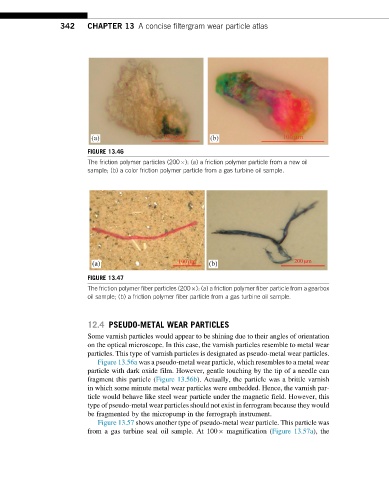
                         FIGURE 13.46
                         The friction polymer particles (200 ): (a) a friction polymer particle from a new oil
                         sample; (b) a color friction polymer particle from a gas turbine oil sample.


                           (a)                    100µm    (b)                     200µm

                         FIGURE 13.47
                         The friction polymer fiber particles (200 ): (a) a friction polymer fiber particle from a gearbox
                         oil sample; (b) a friction polymer fiber particle from a gas turbine oil sample.


                         12.4 PSEUDO-METAL WEAR PARTICLES
                         Some varnish particles would appear to be shining due to their angles of orientation
                         on the optical microscope. In this case, the varnish particles resemble to metal wear
                         particles. This type of varnish particles is designated as pseudo-metal wear particles.
                            Figure 13.56a was a pseudo-metal wear particle, which resembles to a metal wear
                         particle with dark oxide film. However, gentle touching by the tip of a needle can
                         fragment this particle (Figure 13.56b). Actually, the particle was a brittle varnish
                         in which some minute metal wear particles were embedded. Hence, the varnish par-
                         ticle would behave like steel wear particle under the magnetic field. However, this
                         type of pseudo-metal wear particles should not exist in ferrogram because they would
                         be fragmented by the micropump in the ferrograph instrument.
                            Figure 13.57 shows another type of pseudo-metal wear particle. This particle was
                         from a gas turbine seal oil sample. At 100  magnification (Figure 13.57a), the

