


Page 348 - Handbook of Materials Failure Analysis
P. 348
14 Conclusion    345


                                          50µm                              50µm
                   (a)                              (b)
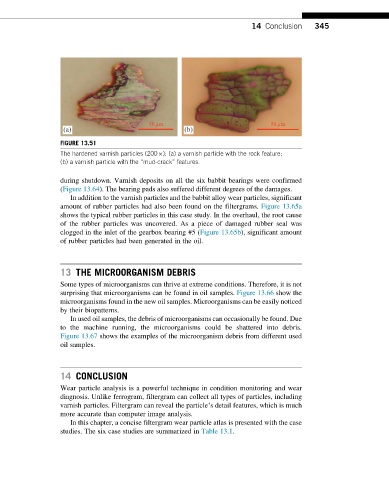
                  FIGURE 13.51
                  The hardened varnish particles (200 ): (a) a varnish particle with the rock feature;
                  (b) a varnish particle with the “mud-crack” features.

                  during shutdown. Varnish deposits on all the six babbit bearings were confirmed
                  (Figure 13.64). The bearing pads also suffered different degrees of the damages.
                     In addition to the varnish particles and the babbit alloy wear particles, significant
                  amount of rubber particles had also been found on the filtergrams. Figure 13.65a
                  shows the typical rubber particles in this case study. In the overhaul, the root cause
                  of the rubber particles was uncovered. As a piece of damaged rubber seal was
                  clogged in the inlet of the gearbox bearing #5 (Figure 13.65b), significant amount
                  of rubber particles had been generated in the oil.


                  13 THE MICROORGANISM DEBRIS

                  Some types of microorganisms can thrive at extreme conditions. Therefore, it is not
                  surprising that microorganisms can be found in oil samples. Figure 13.66 show the
                  microorganisms found in the new oil samples. Microorganisms can be easily noticed
                  by their biopatterns.
                     In used oil samples, the debris of microorganisms can occasionally be found. Due
                  to the machine running, the microorganisms could be shattered into debris.
                  Figure 13.67 shows the examples of the microorganism debris from different used
                  oil samples.


                  14 CONCLUSION

                  Wear particle analysis is a powerful technique in condition monitoring and wear
                  diagnosis. Unlike ferrogram, filtergram can collect all types of particles, including
                  varnish particles. Filtergram can reveal the particle’s detail features, which is much
                  more accurate than computer image analysis.
                     In this chapter, a concise filtergram wear particle atlas is presented with the case
                  studies. The six case studies are summarized in Table 13.1.

