


Page 358 - Handbook of Materials Failure Analysis
P. 358
356    CHAPTER 14 Fatigue failure analysis of welded structures


                         or structure, and the word “fluctuating” means that the loading associated with
                         fatigue is alternating rather than being stationary [1].
                            Although the number of mechanical failures cases is low when compared to suc-
                         cessful components and structures, the cost associated with the failures is over-
                         whelming. A comprehensive study was carried out in 1982 to estimate the cost of
                         fractures in the United States. This study shows that the restitution of mechanical
                         fractures in 1 year was $119 billion, which could have been decreased significantly
                         using appropriate engineering designs, including fatigue design [3].
                            Fatigue failure in metals involves three stages: fatigue crack initiation, crack
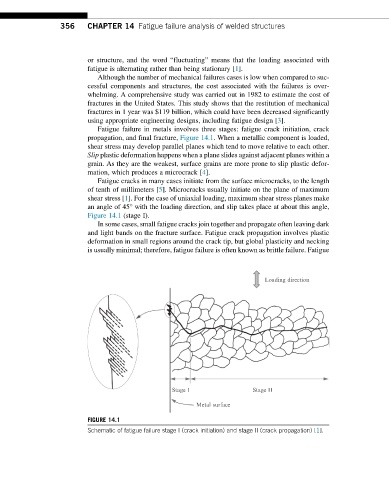
                         propagation, and final fracture, Figure 14.1. When a metallic component is loaded,
                         shear stress may develop parallel planes which tend to move relative to each other.
                         Slip plastic deformation happens when a plane slides against adjacent planes within a
                         grain. As they are the weakest, surface grains are more prone to slip plastic defor-
                         mation, which produces a microcrack [4].
                            Fatigue cracks in many cases initiate from the surface microcracks, to the length
                         of tenth of millimeters [5]. Microcracks usually initiate on the plane of maximum
                         shear stress [1]. For the case of uniaxial loading, maximum shear stress planes make
                         an angle of 45° with the loading direction, and slip takes place at about this angle,
                         Figure 14.1 (stage I).
                            In some cases, small fatigue cracks join together and propagate often leaving dark
                         and light bands on the fracture surface. Fatigue crack propagation involves plastic
                         deformation in small regions around the crack tip, but global plasticity and necking
                         is usually minimal; therefore, fatigue failure is often known as brittle failure. Fatigue


                                                                          Loading direction


                                                 Stage I               Stage II

                                                       Metal surface
                         FIGURE 14.1
                         Schematic of fatigue failure stage I (crack initiation) and stage II (crack propagation) [1].

