


Page 359 - Handbook of Materials Failure Analysis
P. 359
1 Introduction   357


                  cracks often propagate on the plane of maximum normal stress (with exceptions of
                  torsional and multiaxial loading) [1]. When the fatigue crack has reached a critical
                  length, final fracture will occur. Fatigue cracks prior to fracture may range from very
                  small cracks (1% of the fracture surface) to very large cracks ( 100%), depending on
                  the load level and fracture toughness of the material [1].
                     The research on the fatigue of metals started in the nineteenth century [5,6], and
                  since then numerous studies have been performed on this topic. These studies
                  followed two major approaches: fatigue characterization and fatigue modeling.
                  The fatigue characterization approach investigates the macro- and microstructure
                  of materials before, during, and after cyclic loading and explains the mechanism
                  of fatigue failure. The fatigue modeling approach predicts the fatigue failure location
                  and service life of a component or structure under a given loading condition. With all
                  the studies, this phenomenon is still not fully understood because of the complexities
                  involved in the fatigue process [4,7], such as micromechanism of cyclic plastic defor-
                  mation, and determination of the crack propagation path.
                     Fatigue of welds is even more complex. Welding processes often cause liquation
                  and rapid solidification which result in different microstructure in the weld region
                  than in the base metal. Deposition of filler metals in arc welding increases the inho-
                  mogeneity of the weld region. Residual stresses induced in the weld region due to the
                  solidification and shrinkage affect the fatigue strength. Also, stress concentration
                  around the weld and imperfections inside the weld, for example, porosity, undercuts,
                  etc., add to the complexity of the fatigue process [8].
                     In welded structures, the weld regions are very prone to fatigue failure because of
                  the stress concentration, tensile residual stress, etc. Therefore, assessing the fatigue
                  strength of welds has a great significance. This topic has attracted researchers’ atten-
                  tion and several models have been proposed to predict the fatigue life of welded
                  structures. From the fatigue modeling perspective, welded joints are often divided
                  into seam welds and spot-welds [8,9], because they are quite different in stress ana-
                  lyses. The focus in this chapter is on spot-welds; therefore, the common approaches
                  for fatigue modeling of spot-welds are briefly introduced. It is noteworthy that the
                  fatigue models explained in this chapter have been developed based on the fatigue
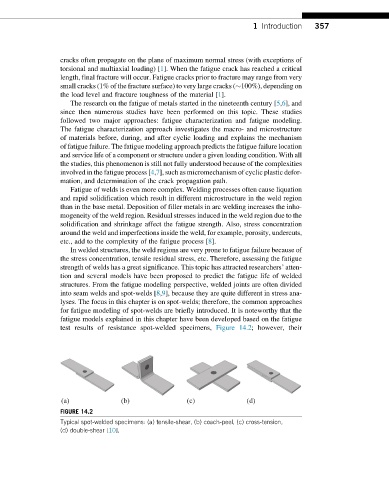
                  test results of resistance spot-welded specimens, Figure 14.2; however, their


                  (a)              (b)               (c)             (d)
                  FIGURE 14.2
                  Typical spot-welded specimens: (a) tensile-shear, (b) coach-peel, (c) cross-tension,
                  (d) double-shear [10].

