


Page 363 - Handbook of Materials Failure Analysis
P. 363
2 Fatigue Modeling of Welded Structures by Local Approaches   361


                     The fracture mechanics approach considers a measure of SIF or J-integral as the
                  fatigue damage parameter, and relates this parameter to the fatigue life or the crack-
                  growth rate. Pook [14], Swellam et al. [15], and Wang et al. [33] proposed different
                  methods for calculating the SIF or J-integral range for spot-welds.
                     Swellam in 1992 [15] proposed a fatigue model for predicting crack propagation
                  life for spot-welds based on the fracture mechanics approach. In this model, the
                  effects of modes I and II loading were taken into account. The spot-weld was con-
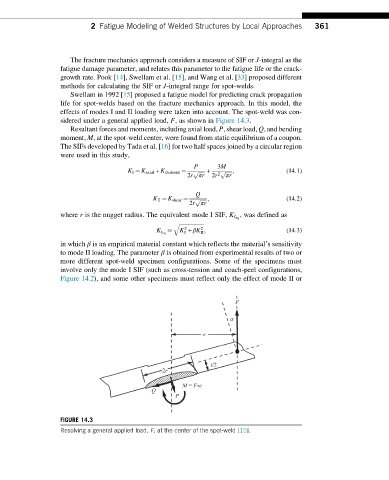
                  sidered under a general applied load, F, as shown in Figure 14.3.
                     Resultant forces and moments, including axial load, P, shear load, Q, and bending
                  moment, M, at the spot-weld center, were found from static equilibrium of a coupon.
                  The SIFs developed by Tada et al. [16] for two half spaces joined by a circular region
                  were used in this study,
                                                       P     3M
                                    K I ¼ K axial + K moment ¼  p ffiffiffiffiffi +  p ffiffiffiffiffi;  (14.1)
                                                     2r πr  2r 2  πr

                                                       Q
                                           K II ¼ K shear ¼  p ffiffiffiffiffi;           (14.2)
                                                     2r πr
                                                                   , was defined as
                  where r is the nugget radius. The equivalent mode I SIF, K I eq
                                                 q ffiffiffiffiffiffiffiffiffiffiffiffiffiffiffiffiffiffi
                                                    2
                                                         2
                                               ¼   K + βK ;                     (14.3)
                                            K I eq  I    II
                  in which β is an empirical material constant which reflects the material’s sensitivity
                  to mode II loading. The parameter β is obtained from experimental results of two or
                  more different spot-weld specimen configurations. Some of the specimens must
                  involve only the mode I SIF (such as cross-tension and coach-peel configurations,
                  Figure 14.2), and some other specimens must reflect only the effect of mode II or


                                                                  F

                                                                 a
                                                         e


                                                           t/2
                                              2r
                                                    M = F •e
                                           Q
                                                  P


                  FIGURE 14.3
                  Resolving a general applied load, F, at the center of the spot-weld [15].

